Best Sand Blasting Cabinet: A Comprehensive Comparison for Industrial Buyers
Choosing the best sand blasting cabinet is no longer just about finding an enclosed machine that can remove rust or clean a component. For manufacturers, fabrication shops, restoration businesses, foundries, engineering workshops, and surface preparation professionals, the cabinet you choose affects productivity, finish quality, abrasive consumption, operator safety, dust control, and long-term operating cost. That is why buyers often search for the best sand blasting cabinet but quickly discover that there is no single model that suits every application.
The best sand blasting cabinet for one workshop may be completely wrong for another. A compact unit for precision parts, for example, will not deliver the same value as a heavy-duty industrial cabinet designed for high-volume steel fabrication. Likewise, a pressure cabinet built for aggressive cleaning may be excessive for a business that mainly handles cosmetic finishing or delicate component restoration. The right comparison, therefore, is not just between brands or sand blasting cabinet costs, but between cabinet types, blasting systems, workpiece sizes, production needs, and the level of surface preparation required.
Why Choosing the Right Sand Blasting Cabinet Matters
In industrial finishing and surface preparation, blasting is often a critical pre-treatment process. Before painting, powder coating, welding, bonding, inspection, or reassembly, parts may need to be cleaned, deburred, stripped, or roughened. If the cabinet is too slow, too small, poorly sealed, or not matched to the blasting abrasive media and workload, it can become a production bottleneck rather than a productivity tool.
A well-matched cabinet helps businesses:
- Remove rust, scale, paint, and contamination more efficiently
- Achieve a more consistent surface finish
- Improve coating adhesion and part quality
- Reduce manual cleaning time and rework
- Control dust and improve visibility inside the cabinet
- Recover and reuse abrasive media more effectively
- Lower downtime caused by poor equipment design
This is why the best sand blasting cabinet is best only when it fits the application, not simply because it has the biggest size or highest pressure rating.
Understanding the Main Types of Sand Blasting Cabinets
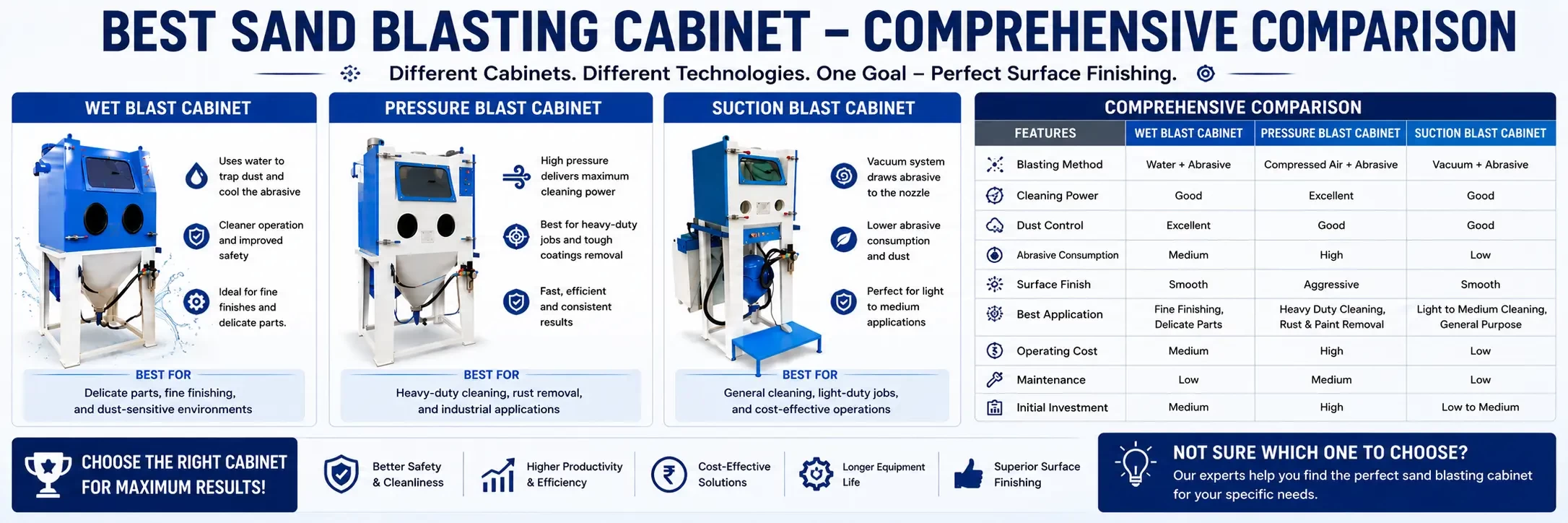
Before comparing features, it is important to understand the major cabinet categories available in the market. Most buyers will choose between suction blasting cabinets, pressure cabinets, wet blasting cabinets, and bench-top or industrial cabinet formats.
Suction Sand Blasting Cabinets
Suction blasting cabinets, also called siphon blast cabinets, use compressed air to create a vacuum that draws abrasive media from a hopper into the blast gun. They are commonly selected for general cleaning, moderate production work, and finishing jobs where extreme blasting force is not necessary.
Best for:
- Light to medium rust removal
- Surface cleaning and maintenance work
- Small to medium components
- Workshops with moderate blasting requirements
- Buyers looking for the lower initial sand blasting cabinet costs
Main advantages:
- Simpler construction
- Lower purchase cost
- Easier maintenance
- Good control for finishing work
Pressure Sand Blasting Cabinets
Pressure blasting cabinets use a pressurized vessel to force abrasive media directly through the sand blasting hose and blasting nozzle. This creates higher abrasive velocity, stronger cutting action, and faster cleaning speed.
Best for:
- Heavy-duty industrial blasting
- Thick rust and mill scale removal
- High-volume production environments
- Surface preparation before coating
- Fabricated steel parts and castings
Main advantages:
- Faster blasting speed
- Better performance on hard contamination
- More aggressive surface profiling
- Stronger productivity for manufacturing use
Wet Blasting Cabinets
Wet blasting cabinets mix abrasive media with water to create a slurry blasting process. They are commonly used when dust reduction, smoother finishing, or gentler treatment is important.
Best for:
- Fine finishing applications
- Delicate parts that may overheat during dry blasting
- Reduced airborne dust
- Mold cleaning and precision component finishing
- Cosmetic surface treatment
Main advantages:
- Lower dust generation
- Improved visibility in certain applications
- Smoother finish on selected materials
- Reduced heat buildup on the part
Benchtop Sand Blasting Cabinets
These are smaller cabinets designed for limited workspace, smaller parts, and lighter-duty operations. Benchtop sand blasting cabinets are often used in maintenance workshops, repair units, tool rooms, and low-volume production setups.
Best for:
- Small components
- Bench-level workshop use
- Precision cleaning
- Light maintenance jobs
- Buyers with space constraints
Large Industrial Sand Blasting Cabinets
A large sand blasting cabinet is built for higher productivity, bigger workpieces, and more demanding operating environments. They often include stronger dust collectors, better abrasive recovery, and more durable construction.
Best for:
- Manufacturing plants
- Foundries and fabrication shops
- Large castings and welded parts
- Repetitive industrial blasting
- High daily operating hours
What Makes a Sand Blasting Cabinet “Best”?
The best cabinet is not defined by one feature alone. A proper comparison should include the following performance and ownership factors.
- Cabinet Type Must Match the Application
The first comparison point is whether the blasting system suits the job. For light cleaning and controlled finishing, a suction cabinet may be ideal. For heavy rust removal, scale cleaning, and production blasting, a pressure blasting cabinet often offers better long-term value. For delicate components and low-dust finishing, a wet blasting cabinet may be the better choice.
A buyer looking for the best sand blasting cabinet should start with the actual blasting requirement, not the machine brochure.
- Workpiece Size Matters More Than Many Buyers Realize
A common buying mistake is choosing a cabinet based only on sand blasting cabinet costs while ignoring the size of the parts that need to be processed. The cabinet should provide enough room for the component, operator hand movement, nozzle control, and safe repositioning of the workpiece.
When comparing blasting cabinet sizes, consider:
- Maximum part length, width, and height
- Weight of the component
- Whether parts will be blasted one by one or in batches
- Whether a turntable, loading trolley, or internal support is required
- Future product size changes in the manufacturing process
A cabinet that is too small can reduce productivity, strain the operator, and make blasting inconsistent.
- Dust Collection Quality Is a Major Differentiator
Two cabinets may appear similar from the outside, but dust collection often separates an average machine from a professional one. A cabinet with poor dust extraction quickly loses visibility, increases dust recirculation, and makes blasting slower and less consistent.
A high-quality cabinet comparison should always include:
- Sand blasting dust collector capacity
- Filter type and maintenance method
- Airflow balance
- Window visibility protection
- Internal lighting quality
- Cabinet sealing against dust leakage
A good dust collection system improves finish consistency, operator comfort, and abrasive reuse efficiency.
- Abrasive Recovery and Reusability Affect Operating Cost
The best cabinet is not just the one that cleans well on day one; it is the one that continues to perform efficiently over time. Abrasive recovery plays a big role in this. A well-designed recovery system helps:
- Separate reusable abrasive from dust and broken fines
- Maintain more consistent blasting performance
- Reduce abrasive consumption
- Lower cleanup time and manual handling
For industrial users running aluminium oxide, glass beads, steel grit, or other reusable media, this can have a major impact on long-term operating cost.
- Build Quality Determines Machine Life
Cabinet blasting is a wear-intensive process. Abrasive media, air pressure, and repeated operator use put stress on every major component of the machine. The best sand blasting cabinets are usually built with heavy-gauge steel, strong door hinges, reliable glove assemblies, replaceable window protection, and wear-resistant internal areas. When comparing build quality, check:
- Cabinet wall thickness
- Door construction and sealing
- Sand blasting nozzle and blast gun quality
- Gloves, foot pedal, and control durability
- Internal lining or wear protection
- Ease of access for service and replacement parts
A cheaper cabinet may look attractive initially, but poor build quality often leads to faster wear, media leakage, and frequent downtime.
Best Sand Blasting Cabinet by Use Case: Which Type of Successes?
Rather than naming a single universal winner, it is more useful to compare the best cabinet type by application.
- Best for light workshop cleaning and budget-conscious users
A suction sand blasting cabinet is often the better choice when the workload is moderate, the parts are relatively small, and the business wants a practical, lower-cost solution.
- Best for industrial productivity and heavy rust removal
A pressure sand blasting cabinet is typically the strongest option for production-focused businesses, especially where thick contamination, fabricated steel, or high throughput are involved.
- Best for fine finishing and lower dust work
A wet blasting cabinet is often the preferred choice for cosmetic finishing, mold cleaning, and applications where dust suppression and smoother treatment are important.
- Best for small components and compact workshops
A bench-top or compact cabinet can be ideal when space is limited, and the work involves smaller tools, fittings, brackets, or precision parts.
- Best for large manufacturing and fabrication plants
A heavy-duty industrial cabinet is the right choice when blasting is part of a regular production process, and the business handles larger parts, repeated jobs, or demanding surface preparation standards.
Key Questions to Ask Before Buying a Blasting Cabinet
To choose the right cabinet, buyers should ask the following before requesting a quotation:
- What material will be blasted?
Mild steel, stainless steel, aluminium, brass, cast iron, and coated components all respond differently to abrasive impact.
- What is the blasting goal?
Rust removal, paint stripping, deburring, matte finishing, oxide removal, coating preparation, and peening all have different machine requirements.
- How many parts will be processed daily?
A machine used occasionally for maintenance does not need the same capacity as one running in a production line.
- Which abrasive media will be used?
Glass beads, aluminium oxide, garnet, steel grit, and plastic abrasive media all influence cabinet design, recovery needs, and wear rate.
- How important is finish quality?
Some jobs need aggressive cleaning, while others need a smooth and visually consistent surface.
- What level of after-sales support is available?
Spare parts, technical support, and machine guidance matter just as much as the initial purchase cost.
Why Choosing the Right Sand Blasting Cabinet Manufacturer Matters
Selecting the right sand blasting cabinet is not only about machine design, but it also depends on the experience and support offered by the manufacturer. A reliable sand blasting cabinet manufacturer should understand the customer’s application in detail before recommending a machine. Factors such as workpiece size, blasting purpose, contamination level, abrasive media, and production volume all play an important role in choosing the most suitable cabinet.
As an experienced sand blasting cabinet manufacturer, we focus on offering application-based solutions rather than one-size-fits-all equipment. The right manufacturer should be able to provide:
- Application-based sand blasting cabinet recommendations
- Custom cabinet design options based on job requirements
- Spare parts and after-sales support
- Guidance on dust collectors and abrasive media selection
- Installation support and machine operating assistance
- Proper explanation of suction-type and pressure-type blasting cabinets
- Transparent pricing based on actual production needs
For industrial buyers, especially those comparing sand blasting cabinet manufacturers in India, choosing a manufacturer with technical knowledge, customization capability, and long-term service support can make a major difference in machine performance, productivity, and operating cost.
Final Comparison: Which Sand Blasting Cabinet Is the Best?
If the question is “Which single machine is the best sand blasting cabinet?” the honest answer is that the best cabinet depends entirely on your use case.
- For low-cost, general-purpose blasting, suction cabinets often offer the best value.
- For speed, aggressive cleaning, and industrial production, pressure cabinets usually lead the comparison.
- For delicate finishing and reduced dust, wet cabinets stand out.
- For small workshops, compact or bench-top cabinets can be the smartest option.
- For large-scale manufacturing, industrial heavy-duty cabinets deliver the strongest long-term return.
The right buying decision comes from matching the machine to the workload, not simply choosing the highest-power option.
For more info about the automatic sand blasting cabinet, visit our webpage.
Finding the best sand blasting cabinet requires more than comparing sand blasting cabinet costs or searching for the most popular model online. A truly good comparison looks at cabinet type, workpiece size, blasting method, abrasive compatibility, dust collection, build quality, recovery efficiency, and supplier support. For some businesses, the best cabinet will be a compact suction unit that handles daily maintenance jobs economically. For others, it will be a pressure blasting cabinet built for fast, high-volume industrial cleaning. And for precision finishing applications, a wet blasting cabinet may offer the best overall result. We also provide the manual sand blasting cabinet, semi-automatic sand blasting cabinet, turbocharger sand blasting cabinet, and benchtop sand blaster cabinet, etc.
The smartest way to choose is to begin with the actual manufacturing requirement: what needs to be cleaned, how often, how fast, and to what finish standard. Once those answers are clear, the best cabinet becomes much easier to identify and far more likely to deliver long-term value in real production conditions.