Sand Blasting Cabinet Problems and Solutions
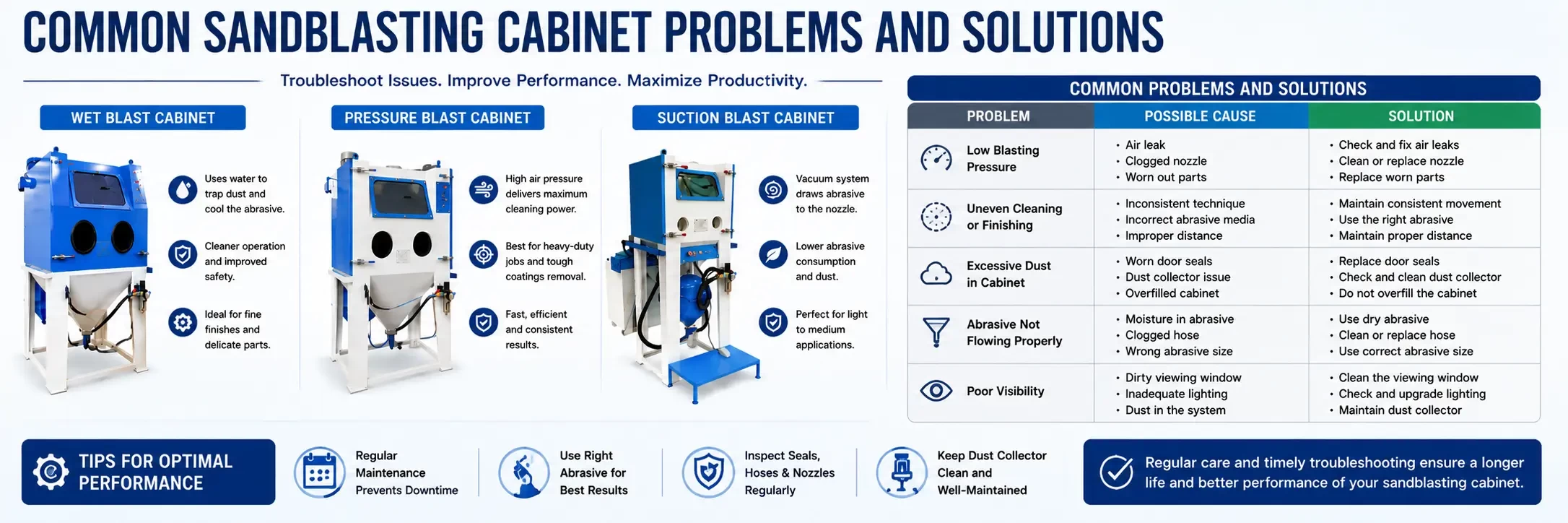
This guide explains the most common sand blasting cabinet problems, why they happen, and the practical sand blasting cabinet solutions that help restore performance. Whether you use a cabinet for industrial production, fabrication work, restoration, foundry cleaning, or workshop maintenance, understanding these issues can help you reduce downtime and improve blasting efficiency. A sand blasting cabinet is one of the most practical machines for controlled abrasive cleaning, surface preparation, deburring, rust removal, and finishing. It helps workshops and industrial users perform blasting in an enclosed environment, recover abrasive media, improve cleanliness, and achieve more consistent results than many open blasting methods. However, like any production machine, a sand blasting cabinet can develop performance issues over time.
Some problems appear suddenly, such as a blocked blast gun or a failed dust collector. Others develop gradually, like reduced blasting power, poor visibility, media contamination, or uneven surface finish. When these issues are not identified early, they can increase operating costs, reduce productivity, waste abrasive, and affect final quality. In many cases, the problem is not the cabinet itself but a worn nozzle, poor maintenance routine, moisture in the air supply, or a mismatch between blasting media and application.
Why Sand Blasting Cabinet Problems Should Be Solved Early
When a cabinet is not performing properly, the effect goes beyond just slower blasting. Surface preparation quality can drop, abrasive usage can increase, operators may take longer to complete the same job, and dust may begin spreading into the work area. Small faults often create bigger problems if they are ignored for too long.
For example, a worn nozzle can increase air consumption and reduce blasting efficiency. A clogged sand blasting dust collector can lower visibility and contaminate the abrasive. A leaking door seal can spread dust outside the cabinet. Moisture in the air line can cause abrasive flow issues and inconsistent finishing. Because blasting performance depends on multiple connected components, troubleshooting should always look at the system as a whole rather than only one visible symptom.
1. Weak Sand Blasting Cabinet Performance
One of the most common complaints is that the cabinet no longer blasts as strongly as before. The operator may notice that rust takes longer to remove, paint stripping becomes slower, or the abrasive stream feels weak and ineffective.
Common causes
- Worn sand blasting nozzle with enlarged opening
- Low compressed air pressure
- Blockage in the blast hose or gun
- Moist or contaminated abrasive media
- Incorrect abrasive size for the job
- Air leaks in the sand blasting hose coupling or fittings
- Reduced pressure in a pressure blasting system
Solution
Start by checking the blast nozzle because it is one of the fastest-wearing parts in the cabinet. Even a small increase in nozzle opening can reduce blasting efficiency significantly. Next, inspect the air pressure at the regulator and confirm that the compressor is supplying adequate airflow. Check the blast hose and gun for internal blockage or media buildup. If the abrasive has absorbed moisture or broken down into fine dust, replace it with clean and dry media. Also, inspect all air connections for leaks that may be reducing performance.
2. Abrasive Media Is Not Flowing Properly
Sometimes the blast gun produces an uneven stream, pulsing flow, or no abrasive flow at all, even though compressed air is available. This is one of the most frustrating problems because it interrupts the job and affects finish consistency.
Common causes
- Damp abrasive media causing clogging
- Blocked media pickup tube or hose
- The sand blasting hopper is not feeding correctly
- Dust or foreign particles mixed with the abrasive
- Incorrect media level in the cabinet hopper
- Worn or damaged gun internals
Solution
Check whether the abrasive media is dry and clean. Moisture is a common reason for poor flow, especially in humid environments or when compressed air contains water. Inspect the media pickup line, hopper outlet, and blast hose for blockages. Remove any oversized debris, rust flakes, paint chips, or broken parts that may be interfering with media movement. If the cabinet uses suction blasting, ensure the pickup tube is correctly positioned and not partially blocked. If the gun internals are worn, replace them to restore proper media draw and flow stability.
3. Poor Visibility Inside the Cabinet
If the operator cannot see the workpiece clearly, blasting becomes slower, less accurate, and more tiring. Poor visibility is one of the most common cabinet complaints and is usually related to dust management, window condition, or lighting.
Common causes
- Dust collector not pulling enough airflow
- Dust collector filter clogged or overloaded
- Excessive abrasive breakdown, creating too much fine dust
- Viewing glass scratched or protective film worn out
- Poor internal lighting
- The cabinet leaks disturbing dust flow and visibility
Solution
First, inspect the dust collector. Empty the collection bin if needed, clean or replace the filter, and check whether suction has dropped. If visibility problems continue, evaluate the abrasive media condition. Media that has broken down into excessive fines creates more airborne dust and should be replaced. Also, inspect the cabinet viewing window and replace any worn protective layer or damaged glass. If the cabinet light is weak or poorly positioned, improve lighting so the blasting area remains clearly visible throughout the process.
4. Dust Escaping from the Cabinet
A properly functioning cabinet should contain most of the dust inside the blasting chamber while the dust collector removes fine airborne particles. If dust is escaping around the cabinet door, glove ports, or viewing panel, the problem needs immediate attention.
Common causes
- Worn door gasket or cabinet seal
- Loose glove mounting rings
- Damaged dust collector hose or poor suction
- Overloaded dust collector filter
- Cabinet latch not closing tightly
- Cracks or gaps around access points
Solution
Inspect all sealing areas, including the door gasket, glove rings, viewing window edges, and service panels. Replace worn seals and tighten loose mounting points. Confirm that the cabinet latch closes securely and creates an even seal. If the cabinet still leaks dust, check the dust collector airflow and inspect sand blasting hoses for cracks or loose joints. Dust leakage often increases when the dust collector is underperforming, so filter maintenance and airflow testing should be part of the troubleshooting process.
5. Abrasive Media Is Wearing Out Too Quickly
Abrasive media is meant to break down gradually with use, but if it becomes dusty, ineffective, or unusable too quickly, operating cost rises and blasting quality drops.
Common causes
- Excessively high blasting pressure
- Wrong abrasive type for the application
- Dust collector pulling away too much fine usable media
- Heavy contamination from rust, paint, or scale
- Poor media separation inside the cabinet
- Moisture contamination is causing clumping and waste
Solution
Check whether blasting pressure is higher than required for the job. Excess pressure can accelerate media breakdown and increase dust generation. Review whether the abrasive type is suitable for the workpiece and finish requirement. If the dust collector is removing too much usable media along with dust, the airflow balance or recovery setup may need adjustment. Also, monitor the level of contamination entering the cabinet from dirty workpieces. In some cases, pre-cleaning very oily or heavily scaled parts can help extend abrasive life.
6. Surface Finish Is Uneven or Inconsistent
If some areas of the part clean well while others remain rough, stained, or incompletely blasted, the problem may be related to blasting technique, media condition, nozzle wear, or visibility.
Common causes
- Worn sand blasting nozzle causing an uneven spray pattern
- Inconsistent media flow
- Operator unable to see the surface clearly
- Wrong abrasive size or type
- Blasting pressure not matched to the material
- Part not positioned correctly inside the cabinet
Solution
Inspect the nozzle and replace it if the spray pattern has widened or become irregular. Make sure the abrasive flow is smooth, and the media is not contaminated. Improve visibility by servicing the dust collector and cleaning the viewing window. Review whether the chosen abrasive is appropriate for the part material and finish target. In some cases, repositioning the workpiece or using a turntable can improve coverage and make blasting more consistent.
7. The Dust Collector Runs but Suction Is Weak
A cabinet dust collector may appear to be running normally while still failing to remove enough dust from the blasting chamber. Weak suction reduces visibility, allows fine dust to settle back into the cabinet, and can contaminate reusable abrasives.
Common causes
- Filter clogged with fine dust
- Dust collection bin is full
- Air leak in the collector hose or cabinet connection
- Collector motor or fan performance issue
- Collector too small for the cabinet or blasting application
- Heavy dust load from unsuitable media or dirty workpieces
Solution
Clean or replace the filter and empty the dust bin. Inspect all collector hoses and joints for leaks that could reduce airflow. If the collector is mechanically running but still not performing well, the fan or motor may need inspection. Also, review whether the collector capacity is adequate for the cabinet size and the amount of dust generated during blasting. A small collector connected to a heavily used industrial cabinet will often struggle even if it is technically working.
8. Gloves Wear Out Too Fast
Cabinet gloves are exposed to abrasive rebound, friction, and constant movement. If gloves keep tearing or wearing out quickly, it usually indicates a combination of heavy blasting conditions and glove positioning issues.
Common causes
- Direct abrasive rebound striking the same glove area repeatedly
- Low-quality or incorrect glove material
- Rough cabinet edges around glove ports
- The operator's hand position is too close to the blast stream
- Age-related hardening and cracking of glove material
Solution
Replace damaged gloves promptly and inspect the glove port area for sharp edges or improper mounting. If blasting conditions are aggressive, use gloves designed for heavy-duty cabinet work. Review the operator technique to ensure the blast stream is not repeatedly striking the glove surface. Regular glove inspection should be part of daily maintenance because even small holes can affect safety and comfort.
9. Moisture in the Cabinet Causes Clogging and Poor Performance
Moisture is one of the most damaging hidden problems in abrasive blasting. Wet or damp media will not flow smoothly, may clog the blast gun, and can cause erratic blasting performance.
Common causes
- Compressor air contains moisture
- The air line moisture separator is not working properly
- Humid storage conditions for abrasive media
- Cabinet left open in damp conditions
- Water entering the system during maintenance or cleaning
Solution
Use clean, dry compressed air and service the moisture separator regularly. Drain water traps and air receivers as needed. Store abrasive media in a dry location and avoid exposing it to humidity for long periods. If the abrasive blasting media has already become damp, remove and replace it rather than trying to continue blasting with contaminated material. Preventing moisture is far easier than troubleshooting repeated clogging later.
10. Cabinet Interior Is Wearing Prematurely
Blasting cabinets are built for abrasive work, but internal wear still occurs over time—especially in high-impact zones. If the cabinet body, hopper, or internal lining is wearing too quickly, it should be corrected before structural damage becomes expensive.
Common causes
- Continuous blasting concentrated at one angle
- Missing or damaged wear liners
- Excessively aggressive blasting pressure
- Incorrect part positioning is causing rebound onto the cabinet walls
- Heavy industrial use without routine inspection
Solution
Inspect the cabinet interior regularly and repair or replace worn liners before the cabinet body is exposed to direct abrasion. Adjust blasting technique and part placement so the rebound does not continuously hit the same cabinet wall or corner. If the application is especially aggressive, discuss reinforced internal protection or a more suitable cabinet configuration with the manufacturer.
11. Cabinet Door Will Not Seal Properly
A poor door seal can reduce dust control, allow abrasive leakage, and weaken overall cabinet efficiency. This issue is often overlooked until dust begins appearing around the machine.
Common causes
- Flattened or damaged door gasket
- Misaligned hinges or latches
- Abrasive trapped in the sealing area
- Cabinet frame distortion from wear or impact
Solution
Clean the sealing surface thoroughly and inspect the gasket for compression damage, cuts, or hardening. Adjust hinges and latches so the door closes evenly. If the gasket is worn, replace it rather than trying to compensate by over-tightening the latch. A proper seal helps maintain better dust control and cabinet performance.
Preventive Steps to Avoid Repeated Blasting Cabinet Problems
While troubleshooting is important, prevention is even more valuable. Many blasting cabinet problems can be avoided through a simple maintenance and operating routine.
Best preventive practices include:
- Inspect the nozzle regularly and replace it before wear becomes severe
- Keep abrasive media clean, dry, and matched to the application
- Service the dust collector and filters on schedule
- Drain moisture from the compressed air system
- Check gloves, window protection, and seals frequently
- Remove oversized debris from the cabinet base and recovery area
- Train operators to report changes in blasting performance early
- Keep essential spare parts such as nozzles, gloves, filters, and window protectors available
When to Repair and When to Upgrade
Not every cabinet problem can be solved with maintenance alone. If the machine is consistently underperforming because it is too small for the workload, lacks adequate dust collection, or cannot deliver the blasting power needed for the application, the issue may be system selection rather than component failure.
Consider an upgrade if:
- Production demand has increased significantly
- Dust collection is permanently undersized
- The cabinet cannot handle the size of the current workpieces
- Pressure blasting is needed, but the cabinet is a light-duty suction blasting cabinet model
- Maintenance costs are becoming too frequent and disruptive
In such cases, upgrading the cabinet or its supporting systems may deliver better long-term value than repeated short-term repairs.
Sand blasting cabinet problems are common, but most of them can be solved quickly when the real cause is identified early. Weak blasting performance, poor visibility, abrasive flow issues, dust leakage, uneven surface finish, glove wear, and moisture-related clogging usually point to a small number of root causes: nozzle wear, dirty or damp abrasive, dust collector problems, air supply issues, or neglected maintenance.
The key to reliable blasting is to treat the cabinet as a complete system rather than just a box with a blast gun. When the nozzle, media, dust collector, air supply, seals, gloves, and visibility components are all maintained properly, the cabinet performs more efficiently, lasts longer, and delivers better surface preparation results. For workshops and industrial users alike, understanding common cabinet problems and sand blasting cabinet solutions is one of the most practical ways to reduce downtime, control operating cost, and maintain consistent blasting quality.