How to Choose the Right Sand Blasting Cabinet
This blog explains how to choose the right sand blasting cabinet for manufacturing operations and what factors matter most when comparing blasting equipment. In modern manufacturing, surface preparation is not just a finishing step; it is a critical process that directly affects product quality, coating adhesion, durability, and production efficiency. Whether a factory produces automotive parts, fabricated metal components, castings, tools, valves, or industrial machinery, choosing the right sand blasting cabinet can significantly improve cleaning performance, finishing consistency, and operating costs.
However, not every cabinet is suitable for every production environment. A machine that works well for small workshop jobs may not perform efficiently in a heavy-duty manufacturing plant. Likewise, a high-capacity pressure blasting cabinet may be unnecessary for delicate precision components that require a lighter blasting approach. That is why manufacturers need to evaluate cabinet type, production volume, component size, abrasive system, dust control, and long-term maintenance before making a purchase decision.
Why the Right Sand Blasting Cabinet Matters in Manufacturing
Manufacturing environments depend on repeatability, speed, and surface quality. In many industries, abrasive blasting machine operation is used to remove rust, mill scale, oxidation, old coatings, burrs, and contaminants before powder coating, painting, welding, assembly, or inspection. If the blasting cabinet is too small, too slow, poorly designed, or not matched to the application, it can create production bottlenecks, inconsistent finishes, and unnecessary operating costs.
The right cabinet helps manufacturers:
- Achieve uniform surface preparation
- Improve coating adhesion and product finish
- Reduce rework and manual cleaning time
- Increase productivity and throughput
- Improve operator safety and visibility
- Minimize abrasive waste and dust problems
- Support consistent quality control across batches
In short, the correct abrasive blasting cabinet system is not only a cleaning tool; it is part of the manufacturing process itself.
Step 1: Sand Blasting Cabinet - Define Your Manufacturing Application Clearly
Before comparing cabinet models, start with the job itself. A blasting cabinet should be selected based on the actual production requirement, not only on price or cabinet size. Ask these questions first:
What material will be blasted in the abrasive blast cabinet?
Different materials behave differently under abrasive impact. Mild steel, stainless steel, aluminium, cast iron, brass, and fabricated assemblies may all require different blasting intensity and media selection.
What is the purpose of the sandblasting Cabinet?
The blasting goal determines the type of machine you need. Common objectives include:
- Rust removal
- Paint stripping
- Surface preparation before coating
- Deburring
- Matte finishing
- Oxide removal
- Cleaning castings
- Mold or tool maintenance
- Decorative texturing
How heavy is the contamination?
Light dust or oxidation can often be handled by a suction sand blaster cabinet, while thick rust, hard scale, or stubborn coatings may require a pressure blasting cabinet system.
What finish do you need?
Some manufacturing applications require aggressive cleaning and deep surface profiling, while others need gentle finishing on delicate components. The finish requirement should guide both the sand blasting cabinet type and abrasive media choice.
Step 2: Match Sand Blasting Cabinet Size to Workpiece Size
One of the most common mistakes buyers make is selecting a cabinet based only on budget rather than the size of the parts being processed. A cabinet should allow operators to load, position, rotate, and blast components comfortably without restricting access. When assessing cabinet size, consider:
- Maximum workpiece length, width, and height
- Weight of the component
- Whether parts are blasted individually or in batches
- Space needed for hand movement and sand blasting nozzle control
- Whether a turntable or trolley system is needed
Small Parts and Precision Work
If your manufacturing unit handles compact components such as brackets, tools, valves, precision-machined parts, fasteners, or laboratory items, a benchtop sand blasting cabinet or compact cabinet may be sufficient.
Medium Components
For pump parts, auto components, fabricated assemblies, housings, or production repair work, a medium-sized cabinet is usually more practical.
Large Fabricated Parts
Heavy industrial manufacturing often requires larger cabinet systems for frames, castings, engine components, fabricated steel parts, and oversized workpieces. In these cases, a large cabinet or blasting room may be more appropriate than a small enclosed unit.
Choosing the correct size prevents operator discomfort and improves blasting efficiency.
Step 3: Understand Pressure vs Suction Cabinet Technology
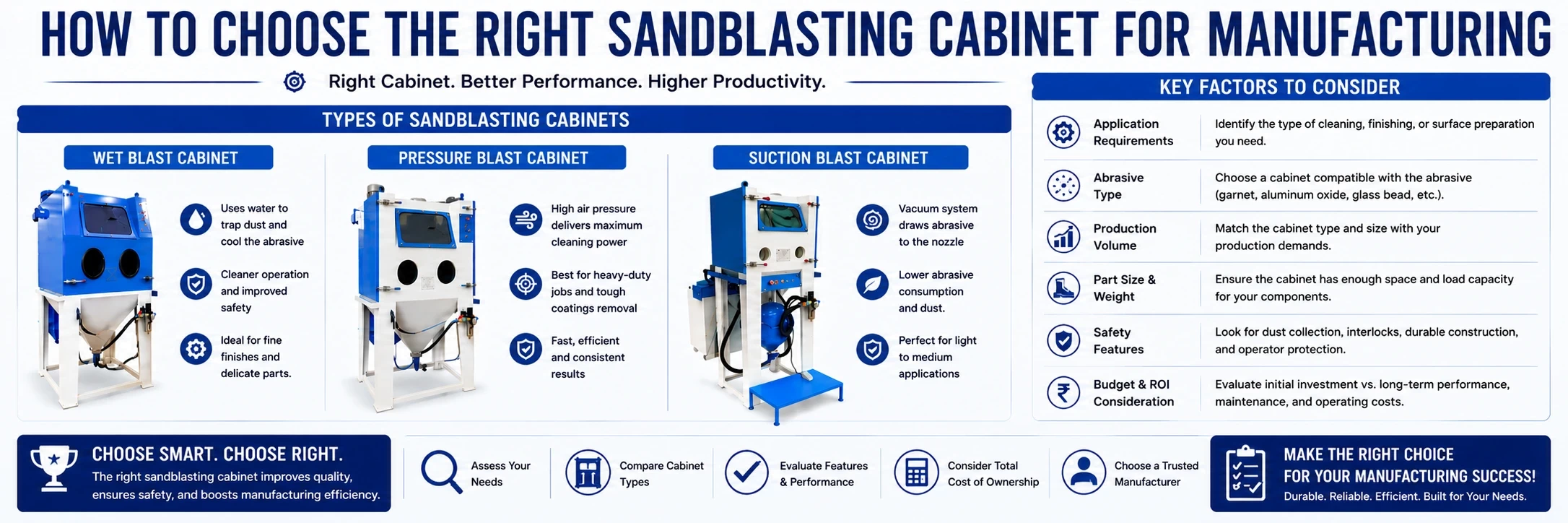
The next major decision is selecting the blasting method. In manufacturing, the two most common cabinet systems are suction and pressure blasting cabinets.
Suction Blasting Cabinets
A suction blasting cabinet uses compressed air to create a vacuum that draws abrasive media from a sand blasting hopper into the blast gun. This system is widely used for general cleaning, light rust removal, finishing, and moderate production work.
Best suited for:
- Light to medium-duty applications
- Lower abrasive consumption
- Precision work
- Small to medium components
- Businesses looking for a lower initial sand blasting cabinet price
Advantages of Suction Blasting Cabinet:
- Simpler design
- Lower purchase cost
- Easier maintenance
- Good for controlled finishing tasks
Pressure Blasting Cabinets
A pressure blasting cabinet uses a pressurized vessel to push abrasive media directly to the nozzle. This creates a stronger blasting force and much faster cleaning speed.
Best suited for:
- Heavy-duty manufacturing
- Thick rust and scale removal
- High production volumes
- Tough coatings and aggressive cleaning
- Faster turnaround requirements
Advantages of Pressure Blasting Cabinet:
- Higher blasting speed
- Better productivity
- More consistent surface profiling
- Excellent for demanding industrial work
Which one should a manufacturer choose?
If your manufacturing process involves high throughput, difficult contamination, or heavy fabricated parts, a pressure cabinet is often the better long-term investment. If the work involves smaller parts, moderate cleaning, or controlled finishing, a suction blasting cabinet may be sufficient.
Step 4: Choose the Right Abrasive Media Compatibility
Not every blasting cabinet is optimized for every abrasive media. The cabinet sand blasting machine should be selected with the abrasive media in mind because media type affects wear rate, blasting performance, recovery system design, and dust load.
Common abrasive media used in manufacturing include:
- Aluminium oxide
- Glass beads
- Steel grit
- Steel shot
- Garnet sand
- Silicon carbide
- Ceramic media
- Plastic media for softer surfaces
Why media compatibility matters
A cabinet designed for glass beads may not perform well with heavier metallic abrasives unless the recovery system, nozzle size, and cabinet lining are suited for that purpose. If you plan to use hard abrasives regularly, the cabinet should have wear-resistant liners, a durable sand blasting hose, and a robust media recovery system.
Step 5: Consider the Dust Collector and Visibility
Dust control is one of the most important features in a manufacturing blasting cabinet. During blasting, abrasive breakdown and the removal of contaminants create airborne dust. Without proper extraction, visibility drops quickly, productivity suffers, and operators may struggle to maintain consistent quality.
A well-designed cabinet should include or support:
- Efficient dust collector system
- High-quality cartridge or bag filtration
- Adequate airflow balance
- Clear viewing window protection
- Proper internal lighting
- Dust-tight cabinet sealing
Why dust control matters in manufacturing
In a production environment, poor visibility slows operators, increases blasting time, and affects finish consistency. A cabinet with a reliable dust collector helps maintain a cleaner workspace, better inspection visibility, and improved process control.
Step 6: Consider Production Volume and Daily Usage
A cabinet that works well for occasional blasting may not survive continuous manufacturing use. That is why daily production volume must be part of the buying decision.
Ask:
- How many parts will be blasted per shift?
- How many hours per day will the cabinet run?
- Is blasting a supporting process or a core production step?
- Will multiple operators use the machine?
- Do you expect future production growth?
Low-volume manufacturing
Smaller cabinets or suction systems may work well for maintenance departments, repair cells, and low-batch production.
Medium to high-volume manufacturing
If blasting is part of regular production, the machine should be built for continuous use. In such cases, look for heavy-duty construction, efficient media recovery, better dust collection, and pressure blasting performance if required.
For more info about the wet blasting cabinet, visit our website.
Step 7: Check Build Quality and Cabinet Construction
In manufacturing, blasting equipment faces continuous abrasive wear. Cabinet build quality directly affects machine life, maintenance frequency, and downtime.
Look for:
- Heavy-gauge steel construction
- Wear-resistant internal lining
- Durable blast gun assembly
- High-quality gloves and seals
- Strong door latches and hinges
- Replaceable window protection
- Stable leg or base design
- Easy access for maintenance
A poorly built cabinet may appear cheaper initially, but it often costs more over time due to part failures, media leakage, and production interruptions.
Step 8: Decide Whether You Need Manual, Semiautomatic, or Customized Equipment
Manufacturers should also consider how much operator involvement the process requires.
Manual Sand Blasting Cabinets
The manual sand blasting cabinet is best for flexible blasting jobs, varying component shapes, and moderate production.
Semiautomatic Sand Blasting Cabinets
Useful where some repetitive handling or improved cycle efficiency is needed.
Customized Sand Blasting Cabinets
A custom cabinet may be the best solution when manufacturing parts are unusually large, fragile, repetitive, or require dedicated fixtures, rotary tables, multiple gun setups, or integrated dust collection.
Customization options may include:
- Turntables
- Trolley loading systems
- Twin gun arrangements
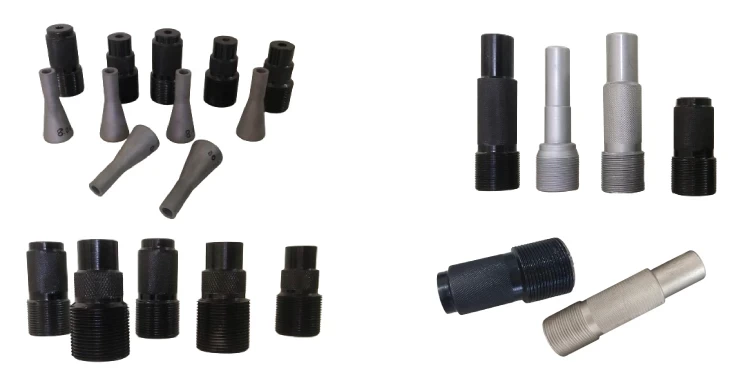
- Special sand blasting nozzle setups
- Internal work supports
- Larger glove ports
- Enhanced lighting
- Automatic media recovery upgrades
If your production line handles a specialized product repeatedly, customization can improve speed and consistency significantly.
Step 9: Evaluate Operating Cost, Not Just Cabinet Sand Blasting Machine Price
Manufacturers often focus on purchase price first, but the real cost of ownership includes much more than the initial quotation. Consider the long-term cost of:
- Abrasive consumption
- Compressed air usage
- Nozzle wear
- Dust collector maintenance
- Replacement gloves and window protectors
- Downtime due to repairs
- Spare parts availability
- Labor time per component
A machine with a slightly higher upfront cost may deliver much lower operating costs over several years if it blasts faster, uses media more efficiently, and reduces maintenance issues.
Step 10: Assess Supplier Expertise and After-Sales Support
Choosing the right supplier is almost as important as choosing the right cabinet. A knowledgeable manufacturer or supplier should ask about your workpiece, application, production volume, finish requirement, and abrasive type before recommending a machine.
A reliable supplier should offer:
- Application-based machine guidance
- Customization options if required
- Spare parts support
- Sand blasting dust collector and nozzle recommendations
- Installation guidance
- Technical support after purchase
- Transparent quotation based on actual needs
This is especially important for manufacturers in India looking for long-term support, fast service, and application-specific cabinet design.
How to Make the Final Decision Regarding Blasting Cabinet
When comparing options, do not ask only, “Which sand blasting cabinet is cheapest?” Instead, ask:
- Which sandblasting cabinet matches our workpiece size?
- Which system will handle our contamination level?
- Which cabinet sand blasting machine fits our daily production target?
- Will the sandblasting cabinet support the abrasive blasting media we want to use?
- Is the sand blasting dust collector system strong enough for regular manufacturing use?
- Can the supplier support maintenance and sand blasting machine spare parts later?
The right cabinet should improve your manufacturing workflow, not create another maintenance problem.
Choosing the right sand blasting cabinet for manufacturing is a strategic decision that affects productivity, finish quality, coating performance, and long-term operating cost. The best choice depends on your component size, blasting application, contamination level, production volume, abrasive media, dust control requirements, and future growth plans. Manufacturers that evaluate these factors carefully are more likely to invest in a cabinet that delivers reliable performance for years rather than simply meeting a short-term budget target.
A well-selected blasting cabinet becomes an essential production asset. It supports cleaner surfaces, better finishing quality, faster turnaround, and more efficient manufacturing operations across industries ranging from fabrication and foundry work to automotive, engineering, and heavy industrial production.