How to Select the Right Dust Collector for Sand Blast Cabinet
A sand blasting cabinet is only as effective as the dust control system connected to it. No matter how powerful the blast gun is, how durable the cabinet construction may be, or how good the abrasive media quality is, poor dust extraction can quickly turn a productive blasting setup into a slow, messy, and inefficient operation. When visibility drops, abrasive media becomes contaminated, dust escapes into the work area, and operators struggle to see the surface clearly, blasting quality and productivity both suffer.
That is why selecting the right dust collector for sand blast cabinet is not a minor accessory decision; it is a core part of cabinet performance. A well-matched dust collector improves visibility, helps separate reusable media from fine dust, supports operator safety, reduces airborne contamination, and contributes directly to finish consistency. On the other hand, an undersized or poorly designed unit can lead to blocked filters, weak suction, excessive maintenance, abrasive loss, and dusty working conditions.
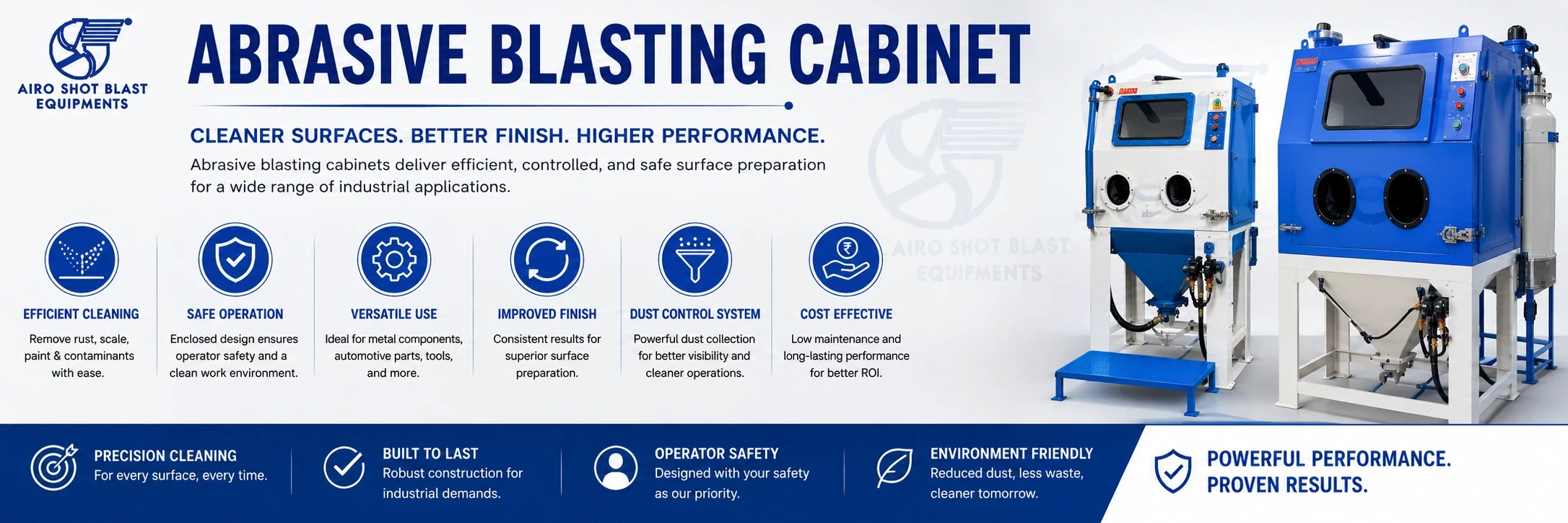
This guide explains how to choose the right dust collector for a sand blast cabinet, what technical and practical factors matter most, and how buyers can compare systems for different cabinet sizes, blasting applications, and production needs. We are also providing the manual sand blasting cabinet, automatic sand blasting cabinet, benchtop sand blasting cabinet, shot blasting cabinet, grit blasting cabinet, turbocharger sand blasting cabinet, etc.
Why Dust Collection Matters in Blast Cabinet Performance
During blasting, abrasive media strikes the workpiece at high speed and breaks down contamination on the surface. At the same time, the blasting process creates fine airborne particles from multiple sources:
- Broken abrasive fines
- Rust, paint, scale, or oxidation removed from the part
- Dust created by abrasive impact
- Small fragments of the blasted substrate or coating
If these particles are not removed efficiently, they begin circulating inside the cabinet. This creates several immediate problems:
- Reduced visibility through the viewing window
- Inconsistent blasting quality due to poor operator sight lines
- Contamination of reusable abrasive media
- Faster wear on cabinet components
- Dust leakage into the surrounding workspace
- Higher operator discomfort and housekeeping burden
- Reduced productivity because blasting becomes slower and more difficult
A properly sized dust collection system prevents these issues by continuously pulling fine airborne dust away from the blasting zone while allowing usable abrasive media to remain in the recovery system.
What a Dust Collector Does in a Sand Blast Cabinet System
A dust collector is designed to extract airborne dust from the cabinet, filter it, and either capture it in a collection area or discharge clean air according to the system design. In a blasting cabinet setup, the dust collector does more than just “clean the air.” It directly supports the blasting process in four important ways:
- It Maintains Visibility Inside the Cabinet
The operator must be able to see the part clearly to blast accurately and consistently. Dust extraction keeps the viewing area clearer and improves control over the blasting process.
- It Protects Abrasive Media Quality
When dust and broken fines are removed properly, the abrasive media remains cleaner and more effective for reuse.
- It Improves Workplace Cleanliness
A strong dust collection setup helps prevent dust from escaping around cabinet doors, glove ports, and access openings.
- It Supports Safer Operation
Although a cabinet is an enclosed system, poor dust control can still create operator exposure during loading, unloading, maintenance, and cabinet cleaning. Better dust management supports a cleaner and safer work environment.
Why Choosing the Wrong Sand Blaster Dust Collector Causes Problems
Many buyers focus on cabinet size and blasting pressure but underestimate the importance of dust extraction. A dust collector that is too small, poorly filtered, or mismatched to the blasting process can create hidden operating costs.
Common problems caused by the wrong collector include:
- Weak airflow and poor dust removal
- Rapid filter clogging
- Frequent maintenance interruptions
- Reduced blasting visibility
- Excessive loss of fine abrasive media
- Dust is settling inside the cabinet and on the part
- Dust leakage into the shop floor
- Lower finish consistency on repeated jobs
This is why a sand blast cabinet dust collector should be selected as part of the blasting system, not as an afterthought.
Key Factors to Consider When Selecting a Dust Collector for Blast Cabinet
Choosing the right dust collector requires more than looking at a product photo or motor size. The correct unit depends on the cabinet, the blasting media, the type of dust generated, and how often the machine will be used.
Start with the Size of the Blast Cabinet
The first step is to consider the cabinet’s internal size and the volume of air that must be managed inside it. A larger sand blasting cabinet usually needs a stronger dust extraction setup because there is more internal space and often a higher dust load. However, size alone does not determine the requirement. Also consider:
- Width, depth, and height of the cabinet
- Number of glove ports or work openings
- Whether the cabinet is bench-top, standard industrial, or large production type
- Whether the operator blasts one small part at a time or larger components with longer cycles
A compact bench-top cabinet may work with a smaller dust collector, while a large industrial pressure cabinet typically requires a more robust filtration and airflow system.
Understand the Type of Abrasive Media Being Used
Different blasting media generate different amounts of dust and break down at different rates. Some abrasives are more durable and create fewer fines, while others fracture faster and increase the dust load inside the cabinet. For example:
- Glass beads may produce a different dust pattern than aluminium oxide
- Garnet sand abrasive, and other mineral abrasives can vary in breakdown rate
- Steel grit and metallic abrasives behave differently from lightweight non-metallic media
- Fine media may circulate differently from coarse abrasive media
This matters because the sand blaster dust collector must be capable of handling the specific dust load created by the chosen media and application.
Consider the Material Being Blasted
Dust does not come only from the abrasive, but also from the workpiece surface. A cabinet blasting clean stainless steel components will create a different dust load than one removing rust, scale, old paint, carbon residue, or foundry contamination. Ask these questions:
- Is the cabinet mainly used for rust removal?
- Will it strip paint or coatings?
- Is it cleaning castings, fabricated steel, aluminium parts, or precision components?
- Does the surface produce heavy contamination during blasting?
A blasting setup handling dirty or coated parts will generally require stronger and more efficient dust extraction than one used only for light finishing.
Match the Dust Collector to Production Volume
Not every blasting cabinet is used in the same way. Some machines are used occasionally for maintenance jobs, while others run continuously in manufacturing or job-work operations. The more hours the cabinet runs each day, the more important it becomes to choose a durable and properly sized collector.
- For low-volume blasting: A compact collector may be enough if the cabinet is used occasionally and for short blasting cycles.
- For medium-volume production: A stronger filtration system with better dust-holding capacity and easier maintenance is usually more practical.
- For heavy industrial use: A robust dust collection system for blast cabinets is essential. It should be designed for continuous airflow, repeated dust loading, and dependable performance over long shifts.
Airflow Capacity Is One of the Most Important Selection Criteria
A dust collector must move enough air to pull fine airborne dust away from the blasting zone without disrupting abrasive flow inside the cabinet. If airflow is too weak, dust remains suspended in front of the operator and visibility drops. If the system is poorly balanced, it may also affect media behavior inside the cabinet.
When comparing collectors, ask the manufacturer or supplier:
- What airflow is recommended for this cabinet size?
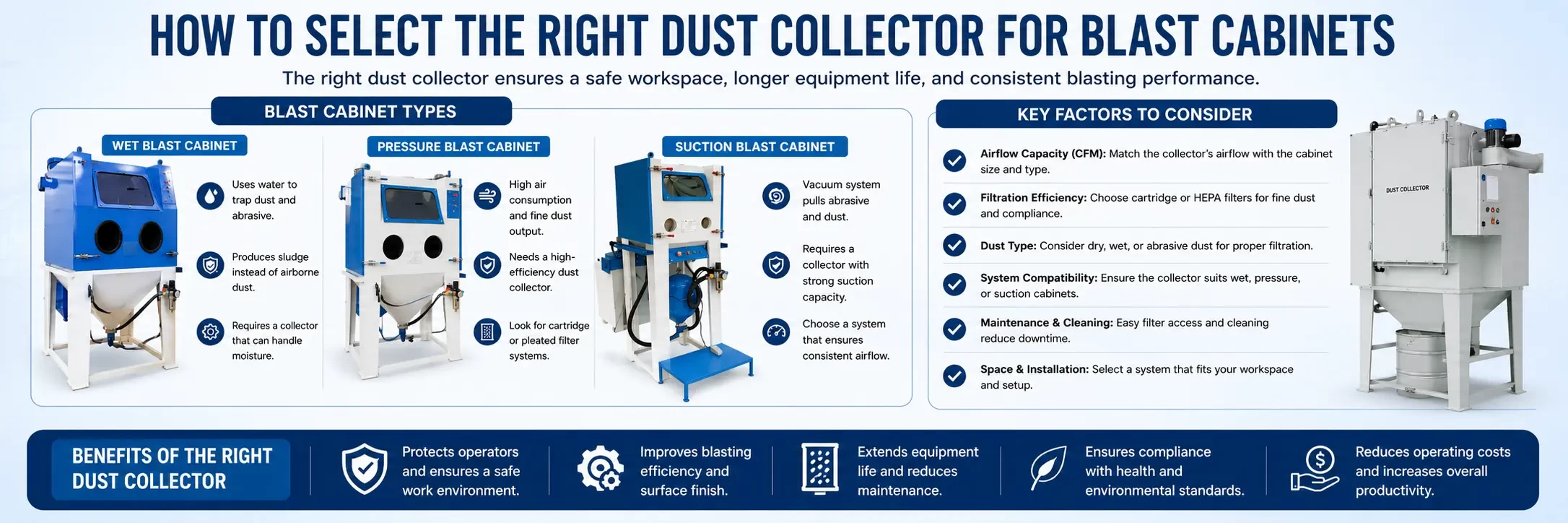
- Is the collector matched to the suction blasting cabinet or the pressure blasting cabinet?
- Can it handle the dust load from the intended abrasive and workpiece type?
- Has it been designed specifically for cabinet blasting applications?
A collector should be selected based on blasting conditions, not just on generic motor specifications.
Filter Design and Cleaning Method Matter
The filter is the heart of the dust collector. Even a powerful blower will not perform well if the filter design is weak, too small, or difficult to maintain. In blasting operations, filters must handle fine dust without causing a sharp drop in airflow.
Important filter considerations include:
- Type of filter media used
- Total filter surface area
- Ability to separate fine dust efficiently
- Ease of filter cleaning or replacement
- Suitability for abrasive blasting dust loads
- Maintenance access and downtime are required for servicing
A good cabinet dust collector should not only capture dust effectively but also maintain stable performance over time without constant interruption for filter cleaning.
Think About Dust Disposal and Maintenance Convenience
In real production environments, ease of maintenance matters almost as much as filtration performance. If the collector is difficult to empty, awkward to access, or prone to frequent blockage, the operator may postpone maintenance, which quickly reduces performance. A practical dust collector should allow:
- Easy access to filters
- Simple dust collection bin removal
- Minimal downtime during cleaning
- Clear inspection points for routine maintenance
- Convenient integration with the cabinet layout
When comparing machines, ask how often the collector will need service under your expected blasting conditions and what parts will need periodic replacement.
Consider Whether You Need an Integrated or Standalone Dust Collector
Some buyers prefer a sand blast cabinet with dust collector as a complete integrated package, while others want a separate collector unit that can be sized independently or upgraded later. Both options can work well, depending on the application.
Integrated system advantages
- Compact footprint
- Simpler installation
- Cabinet and collector designed together
- Often suitable for standard blasting jobs
Separate collector advantages
- More flexibility in sizing
- Easier upgrade path for higher production
- Better access for maintenance in some layouts
- Useful for larger industrial cabinet systems
The right choice depends on available space, production volume, cabinet size, and future expansion plans.
Dust Collector Quality Affects Blasting Quality More Than Many Buyers Realize
A blasting cabinet is often judged by how quickly it removes rust or how smoothly it cleans a component. But the dust collector has a direct effect on both outcomes. If the operator cannot see clearly, blasting becomes slower and less accurate. If abrasive media becomes contaminated with dust, cutting efficiency drops. If dust escapes the cabinet, housekeeping and maintenance problems increase.
In other words, the dust collector is not separate from blasting quality; it is part of blasting quality. This is especially important for:
- Powder coating preparation
- Cosmetic finishing of visible components
- Repetitive production blasting
- Fine glass beads finishing
- Cabinet blasting in enclosed workshops or indoor production areas
How to Select the Right Sand Blaster Dust Collector by Application
A good buying decision starts with the blasting application, not just the collector catalog.
For bench-top and small workshop cabinets
Choose a compact collector that provides adequate airflow, simple maintenance, and reliable dust separation for occasional or moderate blasting work.
For general industrial suction cabinets
Select a medium-capacity collector designed for reusable abrasive media, stable airflow, and good visibility during repeated daily blasting.
For pressure blasting cabinets
Use a stronger collector because the pressure blasting cabinet often generates a heavier dust load and a higher contamination removal rate.
For cabinets handling rusted, painted, or dirty parts
Prioritize dust-holding capacity, strong filtration, and convenient maintenance because contamination levels will be higher.
For production environments with long blasting hours
Choose a heavy-duty system designed for consistent airflow, better filter life, and lower downtime during maintenance.
Questions to Ask Before Buying a Sandblast Cabinet Dust Collector
Before selecting a dust collector, ask the following:
- What cabinet size and blasting type will it support?
- Which abrasive media will be used most often?
- What kind of parts will be blasted?
- How many hours per day will the cabinet run?
- Is the collector integrated or separate?
- How is the filter cleaned or replaced?
- What is the expected maintenance frequency?
- Will the collector support future production growth?
- Is it designed specifically for blast cabinet applications?
These questions help prevent under-sizing, overpaying for unnecessary capacity, or buying a collector that does not match the actual blasting process.
Selecting the right dust collector for sand blast cabinet is one of the most important decisions in building an efficient blasting setup. A well-matched collector improves visibility, protects abrasive quality, reduces airborne dust, supports safer working conditions, and helps maintain consistent blasting performance over time. A poorly chosen collector, on the other hand, can create visibility problems, increase maintenance, contaminate abrasive media, and reduce the overall value of the blasting cabinet itself.
The best choice depends on the size of the cabinet, the abrasive media used, the contamination level of the parts, the daily production volume, and the quality of filtration and airflow needed for the job. Whether you are buying a compact workshop cabinet or a large industrial blasting system, the dust collector should be selected as a core part of the blasting process not as an optional accessory added later. When chosen correctly, it becomes one of the most valuable components in the entire sand blasting machine operation.