Wet Blast vs. Dry Blast Cabinet
Surface preparation and finishing are critical steps in manufacturing, restoration, aerospace, automotive, metal fabrication, and many other industries. Choosing the right blasting method can significantly affect cleaning quality, surface finish, operating costs, and overall productivity. Among the most common abrasive blasting cabinet solutions, Wet Blast vs. Dry Blast Cabinets is a comparison that frequently arises when businesses are selecting equipment for their operations.
While both technologies are designed to clean, prepare, and finish surfaces, they achieve these results in different ways. Wet blasting combines water and abrasive media to create a slurry that is propelled onto the workpiece, whereas dry blasting uses compressed air to accelerate abrasive media directly onto the surface. Each method has unique advantages, limitations, and ideal applications.
In this blog, we explore the differences between wet and dry blast cabinets, helping manufacturers, workshop owners, and industrial buyers determine which solution best fits their needs.
Understanding Blast Cabinets
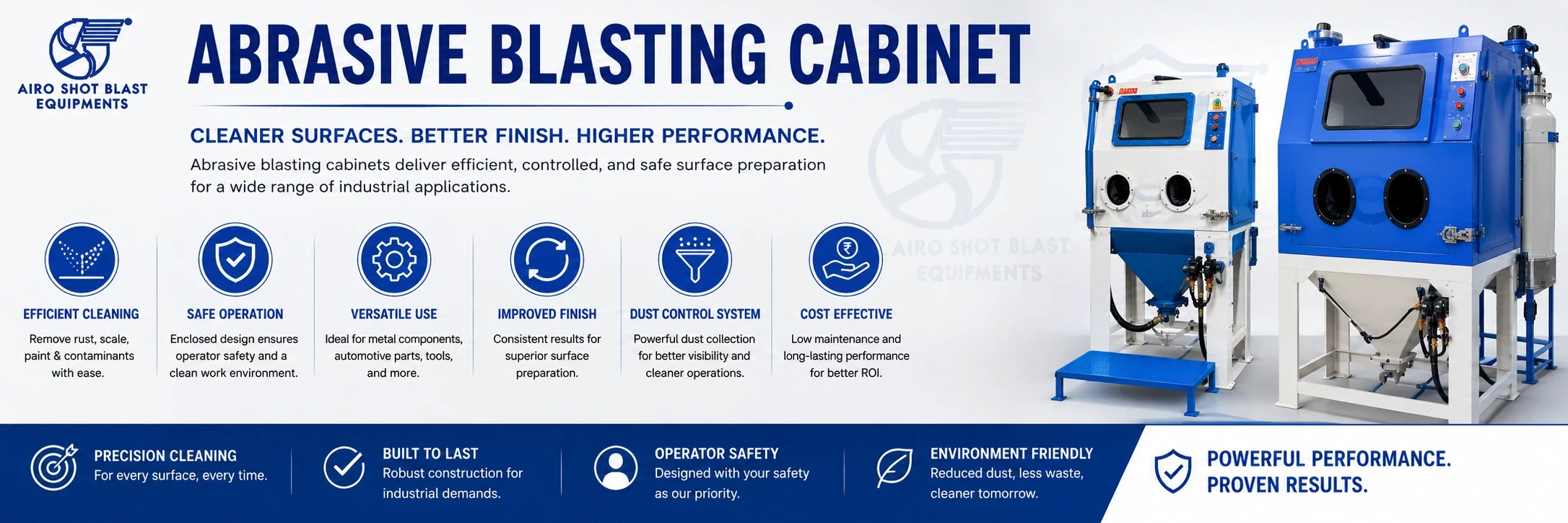
A blast cabinet is an enclosed system designed to perform abrasive blasting in a controlled environment. It allows operators to clean and prepare surfaces while containing dust, recovering abrasive media, and maintaining workplace safety. Sand blast cabinets are commonly used for:
- Rust removal
- Paint stripping
- Surface preparation before coating
- Deburring
- Cleaning castings
- Surface texturing
- Cosmetic finishing
- Restoration projects
The primary distinction between wet and dry cabinets lies in how abrasive blasting media is delivered to the surface.
What Is a Wet Blast Cabinet?
A wet blast cabinet uses a mixture of water and abrasive media to create a slurry. This slurry is pumped through a blasting gun and directed at the workpiece. The presence of water cushions the abrasive impact while reducing airborne dust.
Wet blasting is often selected for applications where surface quality, reduced dust generation, and minimal substrate damage are important considerations.
How Wet Blasting Cabinet Works
The process involves:
- Mixing abrasive media with water.
- Creating a slurry inside the machine.
- Pumping the slurry through the blast gun.
- Accelerating the mixture toward the surface using compressed air.
- Collecting and recirculating the slurry for continued use.
Because water absorbs some impact energy, the blasting action is smoother and less aggressive than dry blasting.
What Is a Dry Blast Cabinet?
A dry blast cabinet uses compressed air to propel abrasive media directly onto the workpiece without water. This method is widely used for industrial cleaning, coating removal, and aggressive surface preparation.
A cabinet-type dry sand blasting machine is one of the most common abrasive finishing methods because of its versatility and ability to process a wide range of materials and contaminants.
How Dry Blasting Cabinet Works
The process generally includes:
- Loading abrasive media into the cabinet hopper.
- Supplying compressed air to the blasting gun.
- Accelerating abrasive particles through the nozzle.
- Impacting the workpiece surface at high speed.
- Recovering reusable abrasive media.
Dry blasting offers higher cutting power and faster material removal than wet blasting in many applications.
Key Differences Between Wet and Dry Blast Cabinets
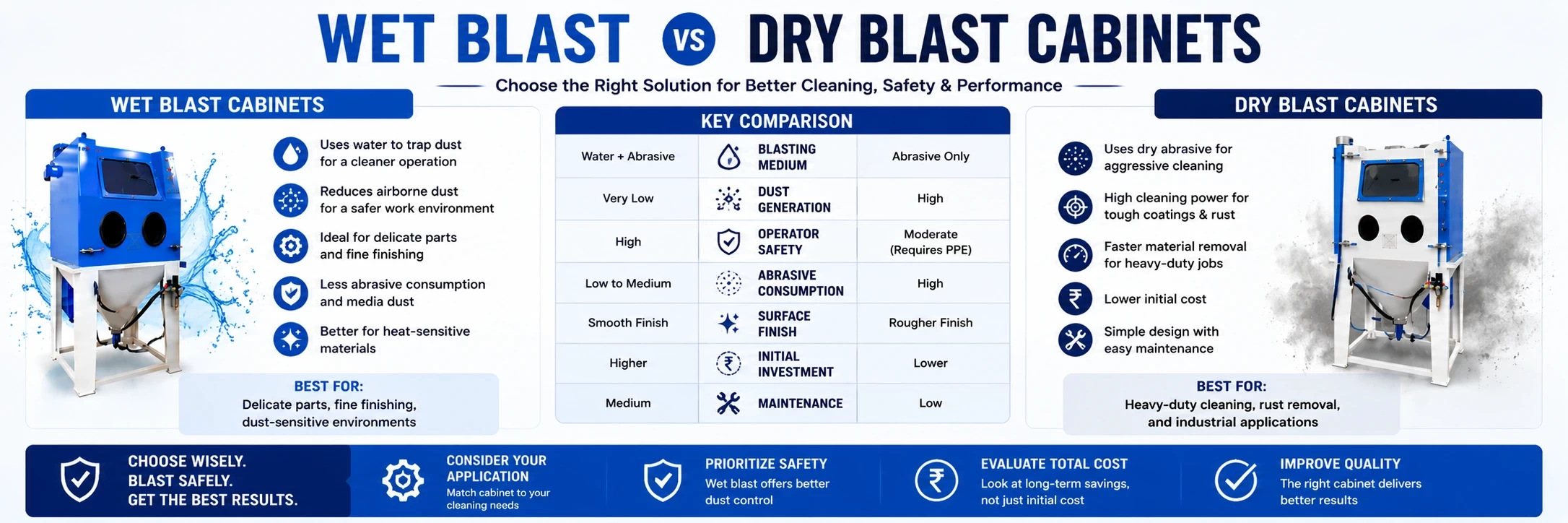
Although both technologies use abrasive media, they differ significantly in performance, operation, maintenance, and finish quality.
1. Dust Generation
One of the most noticeable differences is dust production.
Wet Blasting Cabinet
Water suppresses airborne particles during blasting. As a result:
- Dust generation is dramatically reduced.
- Visibility inside the wet blasting cabinet remains consistent.
- Operator exposure to airborne contaminants is minimized.
- The work environment stays cleaner.
Dry Blasting Cabinet
Dry blasting naturally creates airborne dust because abrasive particles impact the surface at high velocity.
While modern dust collection systems effectively control most dust, they require proper maintenance and filtration to maintain visibility and performance.
2. Surface Finish Quality
The desired finish often determines which blasting method is more appropriate.
Wet Blast Cabinet
Because water cushions the abrasive impact:
- Surface finishes are smoother.
- The process reduces the embedding of abrasive particles.
- Delicate components experience less surface damage.
- Cosmetic finishes are often more uniform.
Wet blasting is commonly used for stainless steel, aluminum, titanium, and precision-machined parts.
Dry Blast Cabinet
Dry blasting provides:
- More aggressive cleaning action.
- Higher surface roughness when needed.
- Better anchoring profiles for coatings.
- Faster removal of contaminants.
It is widely used when preparing surfaces for painting, powder coating, or thermal spray applications.
For more info about the dry ice blasting machine, visit our webpage.
3. Cleaning Speed
Productivity is often a major consideration in industrial environments.
Wet Blast Cabinets
The water component cushions abrasive media impact, reducing aggressiveness.
As a result:
- Material removal rates are often slower.
- Heavy rust and thick coatings may require more processing time.
- Production cycles can be longer.
Dry Blast Cabinets
Dry blasting typically offers:
- Faster cleaning rates.
- More aggressive coating removal.
- Improved productivity for heavy-duty applications.
- Better performance on heavily contaminated surfaces.
4. Surface Damage Risk
Some materials require careful treatment to avoid damage.
Water Blasting Cabinet
The lubricating effect of water helps:
- Reduce surface peening.
- Minimize heat buildup.
- Lower the risk of warping thin materials.
- Protect delicate components.
This makes wet blasting popular in aerospace and precision manufacturing industries.
Dry Blasting
Although highly effective, aggressive blasting pressure and media selection can increase the risk of:
- Surface deformation
- Excessive roughness
- Material removal beyond specifications
Proper pressure settings and abrasive selection are critical.
For more info about the dustless blasting machine, visit our webpage.
5. Corrosion Considerations
Water introduces unique factors that must be considered.
Wet Blasting
Because water is involved:
- Parts must be dried properly after blasting.
- Flash rust may occur on carbon steel.
- Corrosion inhibitors may be required.
- Additional drying equipment may be necessary.
Dry Blasting
Dry blasting eliminates moisture-related concerns.
Benefits include:
- Immediate coating preparation.
- No drying process.
- Reduced risk of flash rusting.
6. Abrasive Media Performance
Media behavior differs significantly between the two methods.
Wet Blasting Cabinets
Water helps:
- Reduce abrasive breakdown.
- Extend media life.
- Minimize dust generation from media degradation.
- Produce smoother finishes.
Dry Blasting Cabinets
Dry systems may:
- Generate more media breakdown.
- Produce additional dust over time.
- Require more frequent media replacement in some applications.
For more info about the granite engraving machine, visit our website.
Industrial Applications of Wet Blast Cabinets
Wet blast systems are commonly used in industries requiring precision finishing and superior surface quality.
Aerospace Industry: Aircraft components often require
- Precision cleaning
- Oxide removal
- Surface conditioning
- Damage-free finishing
Wet blasting is ideal because it minimizes substrate damage while maintaining excellent finish quality.
Medical Device Manufacturing: Medical components require
- Clean surfaces
- Controlled finishes
- Minimal contamination
The cabinet wet blasting machine helps achieve these requirements consistently.
Automotive Restoration: Many restoration professionals use wet blasting for
- Engine components
- Aluminum castings
- Carburetors
- Transmission housings
The process cleans effectively without excessive surface erosion.
Tool and Mold Cleaning: The cabinet wet blasting machine helps remove deposits while preserving critical dimensions and surface quality.
Industrial Applications of Dry Blast Cabinets
Dry blasting remains the dominant solution for many heavy-duty industrial applications.
Steel Fabrication: Dry blasting is widely used for
- Rust removal
- Scale removal
- Surface preparation before painting
Its aggressive cleaning capability improves coating adhesion.
Foundries: Foundry operations use dry blasting for:
- Casting cleanup
- Sand removal
- Surface conditioning
The process handles heavy contamination efficiently.
Manufacturing Facilities: Production environments rely on dry blasting for:
- Deburring
- Cleaning fabricated parts
- Preparing surfaces for coating
Its speed supports high-volume throughput.
Maintenance Workshops: Repair and maintenance facilities frequently use dry cabinets for cleaning machinery, tools, and industrial components.
Cost Comparison
Investment cost can influence equipment selection.
Wet Blast Cabinets: Generally involve
- Higher initial investment
- Water management systems
- Slurry pumps
- Additional maintenance requirements
However, they may reduce media consumption and improve finish quality.
Dry Blast Cabinets: Often feature
- Lower equipment costs
- Simpler operation
- Easier installation
- Lower system complexity
These advantages make them attractive for many workshops and industrial users.
Which Blast Cabinet Is Right for Your Business?
The best choice depends on application requirements rather than simply selecting the more powerful system.
Choose wet blasting cabinet if you need:
- Superior cosmetic finishes
- Reduced dust generation
- Precision cleaning
- Minimal substrate damage
- Longer abrasive life
Choose dry blasting cabinet if you need:
- Fast production rates
- Aggressive surface preparation
- Heavy rust removal
- Lower equipment cost
- Simpler operation
Evaluating production volume, material type, finish requirements, and budget will help determine the most suitable solution.
The debate between wet and dry blast cabinets ultimately comes down to application requirements. Wet blasting offers outstanding finish quality, reduced dust, and gentle surface treatment, making it ideal for precision components and cosmetic finishing. Dry blasting delivers higher cleaning speed, stronger surface preparation, and greater productivity, making it the preferred choice for industrial manufacturing, steel fabrication, and heavy-duty cleaning.
As a trusted sand blasting cabinet manufacturer in India, we provide high-quality abrasive blasting cabinets for cleaning, finishing, deburring, and surface preparation. Our range includes pressure blast cabinets, suction blast cabinets, wet blasting cabinets, benchtop sand blasting cabinets, automatic sand blasting cabinets, large sand blasting cabinets, turbocharger sand blasting cabinets, and customized solutions tailored to specific production needs.
By understanding the strengths and limitations of each technology, businesses can select the blasting solution that aligns with their production goals, surface finishing requirements, budget, and long-term operational needs. The right choice not only improves efficiency but also enhances product quality and overall return on investment.