In today’s highly competitive manufacturing industry, achieving superior product quality requires more than just precision machining. Proper surface preparation has become a critical factor in improving coating performance, durability, and overall product reliability. Whether a component is prepared for painting, powder coating, electroplating, welding, thermal spraying, or assembly, a clean and properly treated surface ensures better adhesion and long-lasting results. Contaminants such as rust, mill scale, oil, grease, paint residue, and oxidation can negatively affect the final finish and cause premature coating failure.
To overcome these challenges, industries are increasingly adopting advanced surface cleaning solutions like a Shot Blasting Cabinet. These machines provide efficient, uniform, and controlled abrasive blasting inside an enclosed workspace, making them ideal for removing surface impurities and preparing components for further processing. A modern Industrial Shot Blasting Machine helps manufacturers achieve consistent surface finishes while reducing material wastage and improving workplace safety.
As a leading Cabinet Shot Blasting Machine Manufacturer and Supplier, companies are focusing on developing advanced systems that meet the growing requirements of automotive, aerospace, foundries, fabrication, engineering, railway, defense, and construction industries. From compact models for small workshops to Heavy Duty Shot Blasting Cabinets for large industrial components, these machines offer reliable performance and high productivity.
The demand for a Cabinet Shot Blasting Machine in India is continuously increasing due to rapid industrial growth and the need for efficient surface treatment solutions. Manufacturers now prefer Automatic Cabinet Shot Blasting Machines that provide better accuracy, faster processing, reduced labor dependency, and improved operational efficiency. Choosing the right machine depends on several factors, including application requirements, production volume, machine capacity, features, and Cabinet Shot Blasting Machine Price.
With years of expertise in engineering and manufacturing, a trusted Shot Blasting Machine Manufacturer in India provides customized solutions designed to deliver excellent surface preparation results. This comprehensive guide explains the working principle, components, types, applications, benefits, maintenance requirements, and important buying considerations of Cabinet Shot Blasting Machines to help industries make the right investment decision.
Why Surface Preparation is Important
Many manufacturers focus heavily on machining accuracy while underestimating the importance of surface preparation. However, studies have shown that coating failures are often caused by inadequate cleaning rather than poor paint quality.
Rust, scale, grease, and oxidation create weak bonding areas that prevent coatings from adhering properly. As a result, paint may peel, powder coatings may chip, and corrosion can develop beneath the coating layer.
A Cabinet Shot Blasting Machine eliminates these contaminants and creates a controlled surface profile that improves coating adhesion. The resulting finish enhances corrosion resistance, extends product life, and reduces maintenance costs.
Surface preparation is also essential for processes such as welding and adhesive bonding. Clean surfaces improve weld quality, reduce defects, and ensure stronger joints. In industries where precision is critical, such as aerospace and medical equipment manufacturing, consistent surface quality is vital for maintaining product reliability.
How Does a Cabinet Shot Blasting Machine Work?
Although the blasting process appears simple, it involves several coordinated systems working together to achieve efficient surface preparation.
Loading the Component: The operator opens the cabinet door and places the workpiece inside. Depending on the machine design, the component may be positioned on a perforated worktable, rotary table, turntable, or custom fixture.Proper positioning ensures that all surfaces can be reached during blasting and minimizes handling time.
Closing the Cabinet: Once the workpiece is positioned correctly, the cabinet door is securely closed. Safety interlocks on many machines prevent blasting from starting until the door is fully locked, protecting the operator from accidental exposure to abrasive particles.
Starting the Blasting Process: When the operator presses the foot pedal or trigger, compressed air flows through the blast gun. This air stream accelerates the abrasive media through a wear-resistant nozzle at very high speed. The high-velocity abrasive strikes the workpiece, removing rust, paint, scale, burrs, and other contaminants while creating the desired surface profile.
Abrasive Recovery: After impact, the abrasive falls into the hopper beneath the work area. Instead of being discarded, reusable media is collected and transported to the recovery system.
Dust Separation: A cyclone separator and dust collector remove fine dust, broken abrasive particles, and contaminants from the reusable media. This continuous cleaning process maintains blasting efficiency and improves visibility inside the cabinet.
Media Recycling: The cleaned abrasive is automatically returned to the blast gun for reuse. High-quality steel shot and grit can often be recycled hundreds of times, significantly reducing operating costs.
Inspection: After blasting is complete, the operator inspects the component under the cabinet's internal lighting. If additional cleaning is required, the process can be repeated until the desired finish is achieved.
Major Components of a Cabinet Shot Blasting Machine
A cabinet blasting system consists of several carefully engineered components that work together to deliver efficient and reliable performance.
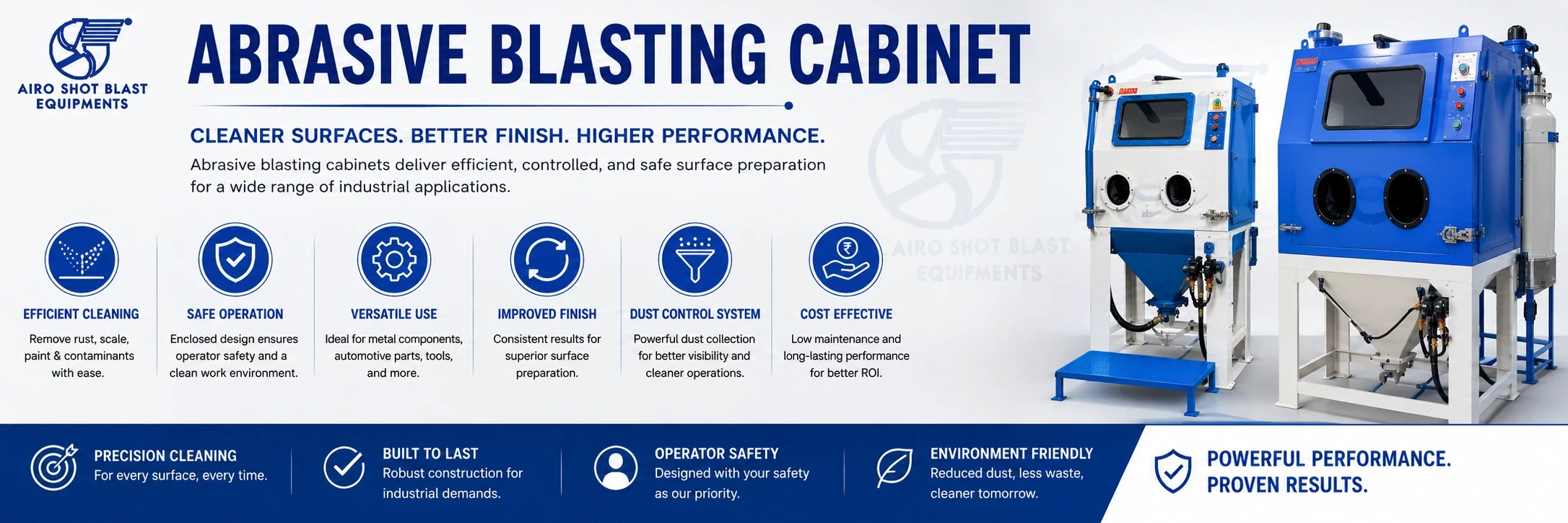
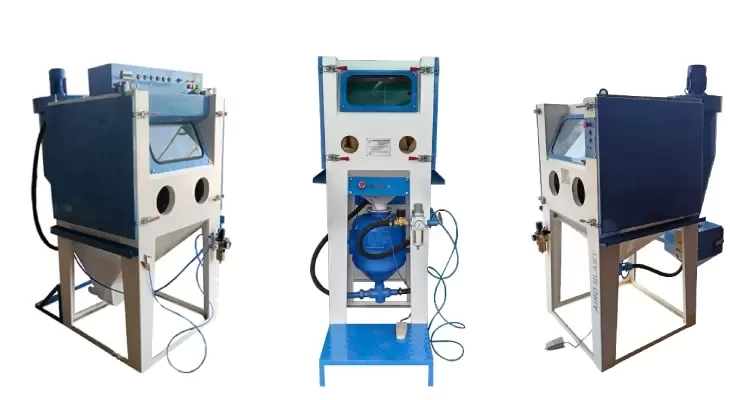
Blast Cabinet: The blast cabinet is the primary enclosure where the blasting operation takes place. It is typically fabricated from heavy-gauge steel to withstand continuous abrasive impact. The interior is lined with replaceable wear-resistant rubber or manganese steel liners that protect the cabinet walls and extend service life.
The cabinet also includes a large viewing window, internal lighting, glove ports, and access doors designed for operator convenience and safety.
Blast Gun: The blast gun controls the direction and intensity of the abrasive stream. Ergonomically designed blast guns reduce operator fatigue while ensuring accurate cleaning of intricate components. High-quality guns provide consistent abrasive flow and excellent control, resulting in uniform surface finishes.
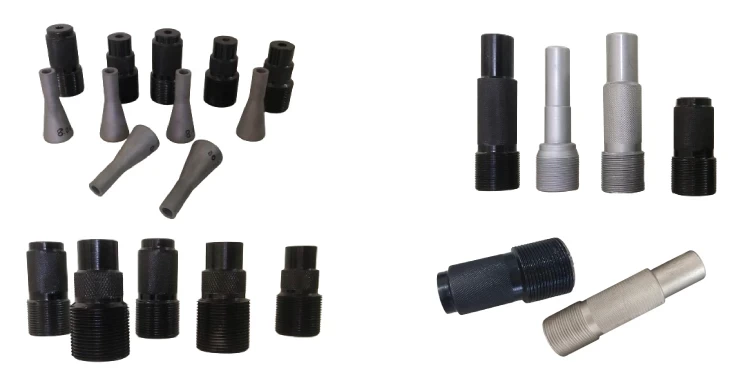
Blast Nozzle: The nozzle converts compressed air into a high-velocity abrasive stream. Materials such as tungsten carbide and boron carbide are commonly used because of their exceptional wear resistance. Selecting the correct nozzle size directly influences productivity, air consumption, and blasting efficiency.
Dust Collection System
During blasting, dust and fine abrasive particles are generated continuously. A powerful dust collector removes these contaminants, maintaining clear visibility inside the cabinet and reducing airborne particles in the workplace. Clean air not only improves operator comfort but also helps maintain consistent blasting performance.
Abrasive Hopper: The abrasive hopper acts as a storage chamber for reusable blasting media. Once the abrasive strikes the workpiece, it falls into the hopper, where it is collected before being recycled back into the blasting system.
A properly designed hopper ensures:
-
Continuous abrasive flow
-
Reduced media wastage
-
Better recycling efficiency
-
Smooth blasting operation
-
Lower operational costs
Most industrial machines are designed with a sloped hopper to ensure gravity-assisted movement of abrasive media.
Cyclone Separator : The cyclone separator is one of the most important parts of an Abrasive Blasting Cabinet.
During blasting, reusable abrasives get mixed with dust, paint flakes, rust particles, and broken media. If these contaminants are reused, blasting quality decreases significantly.
The cyclone separator uses centrifugal force to separate:
-
Heavy reusable abrasive
-
Fine dust particles
-
Broken abrasive
-
Rust
-
Paint residues
Only clean abrasive returns to the blast gun.
Benefits
-
Longer abrasive life
-
Better surface finish
-
Reduced nozzle wear
-
Consistent blasting quality
-
Lower operating cost
Dust Collector
Every Industrial Shot Blasting Machine generates fine airborne dust.
Without an efficient dust collection system:
-
Visibility becomes poor.
-
Operators cannot inspect the workpiece properly.
-
Health hazards increase.
-
Production quality decreases.
Modern dust collectors include:
-
Cartridge filters
-
Bag filters
-
Pulse jet cleaning
-
high -efficiency suction blower
The dust collector continuously removes airbones particles, maintaining a clean working environment.
Advantages
-
Better visibility
-
Cleaner workplace
-
Longer filter life
-
Improved operator safety
-
Compliance with industrial safety standards
Viewing Window
The operator performs blasting while observing the components through a large viewing window.
Most manufacturers use:
-
Toughened glass
-
Safety glass
-
Replaceable protective film
The protective film prevents abrasive impact from damaging the main glass.
Rubber Gloves
Heavy-duty rubber gloves are permanently attached to the cabinet.
These gloves allow the operator to:
-
Hold components
-
Rotate workpiece
-
Perform precision blasting
Without exposing hands to abrasive particles.
Industrial gloves are resistant to:
-
Abrasion
-
Cuts
-
Chemical exposure
-
Continuous industrial use
Foot Pedal Control
The foot pedal controls abrasive flow:
Advantages include:
-
Hands remain free
-
Better operator control
-
Improved safety
-
Reduced fatigue
-
Higher productivity
Air Pressure Regulator
The blasting pressure determines:
-
Cleaning speed
-
Surface roughness
-
Abrasive consumption
A pressure regulator allows precise adjustment according to different materials.
-
Aluminum 40-60 PSI
-
Stainless steel 60-80 PSI
-
Mild steel: 80-100 PSI
-
Heavy Rust Removal 100-120 PSI
Internal LED lighting
Proper illumination helps operators inspect the blasting process.
Modern machines use:
-
LED lights
-
Dust-proof Lighting
-
Shock-resistant fixtures
Good lighting improves quality control and reduces operator errors.
Types of Cabinet Shot Blasting Machines
Different industries have different surface preparation requirements. As a result, manufacturers offer multiple types of cabinet shot blasting machines, each designed for specific applications.
Suction Blast Cabinet
The suction blast cabinet is the most commonly used manual blasting system.
Instead of pushing abrasives under pressure, it creates a vacuum effect using compressed air.
The vacuum draws abrasive from the hopper toward the blast gun.
Working Principle
-
Compressed air passes through the blast gun.
-
This creates suction.
-
The suction lifts abrasively into the air stream.
-
The abrasive exits the nozzle at high speed
-
It strikes the component
-
The used abrasive falls back into the hopper.
-
The process repeats continuously.
Advantages of a Suction Blast Cabinet
-
Low investment cost
-
Easy maintenance
-
Less abrasive consumption
-
Suitable for beginners
-
Uniform surface finish
-
Ideal for small workshops
-
Simple operation
-
Low maintenance reqirements
Applications
-
A suction Blast Cabinet is widely used for:
-
Automobile parts
-
Machine tools
-
Bicycle components
-
Engineering components
-
Die & mould cleaning
-
Small casting
-
Restoration work
-
Maintenance workshops
Limitations
Although highly economical, suction systems are slower than pressure blasting systems.
-
They are not recommended for:
-
Heavy rust
-
Thick paint removal
-
Large fabrication
-
Heavy castings
Pressure Blast Cabinet
A pressure blast cabinet stores abrasives inside a pressure vessel.
Compressed air pressurizes both air and abrasive simultaneously.
This delivers much higher blasting speed.
Advantages
-
Compared with suction blasting:
-
3-5 times faster
-
Higher cleaning efficiency
-
Better productivity
-
Suitable for heavy industrial use
-
Faster rust removal
-
Better coating preparation
Applications
-
Pressure blast cabinets are used for:
-
Heavy fabrication
-
Structural steel
-
Railway components
-
Oil & gas equipment
-
Pressure vessels
-
Shipbuilding
-
Mining equipmet
Automatic Cabinet Shot Blasting Machine
Modern factories increasingly prefer the automatic cabinet shot blasting machine.
Instead of manual blasting, PLC systems control the complete process.
The operator simply loads the component.
Everything else is automatic.
Automatic Features
-
PLC control
-
Touch screen interface
-
Automatic rotation
-
Automatic nozzle movement
-
Timer control
-
Conveyor system
-
Robotic blasting
-
Automatic dust collection
Benefits
An Automatic cabinet shot blasting machine provides:
-
Consistent quality
-
Lower labour cost
-
Higher productivity
-
Repeatable results
-
Better efficiency
-
Less operator fatigue
Heavy Duty Shot Blasting Cabinet
A heavy duty shot blasting cabinet is specifically designed for oversized industrial components.
-
Thick steel construction
-
Large cabinet
-
Heavy worktable
-
High-capacity dust collector
-
Powerful pressure system
Suitable for
-
Steel fabrication
-
Structural components
-
Large castings
-
Railway equipment
-
Construction machinery
-
Crane parts
-
Mining equipment
Advantages
-
Longer machine files
-
Heavy production capacity
-
Faster cleaning
-
Better durability
-
Industrial grade construction
Wet Blasting Cabinet
Unlike dry blasting, wet blasting mixes abrasively with water.
The slurry removes contaminants while suppressing dust.
Advantages
-
Dust free operation
-
mSooth finish
-
Lower heat generation
-
Reduced abrasive embedding
-
Better for delicate components
Applications
-
Aerospace Parts
-
Medical Instruments
-
Stainless Steel
-
Precision Components
-
Decorative Finishing
Abrasive Media Used in Cabinet Shot Blasting Machines: The choice of abrasive media has a direct impact on cleaning speed, surface finish, operating cost, and component life. Selecting the right abrasive depends on the material being processed, the desired finish, and production requirement.
Steel Shot: Steel shot is one of the most widely used metallic abrasives. It consists of spherical particles that provide a smooth and uniform finish.
Best for:
-
Surface cleaning
-
Peening
-
Paint preparation
-
Rust removal
-
General industrial applications
Advantages:
-
Long service life
-
High recyclability
-
Consistent finish
-
Cost-effective for large production
Steel Grit: Steel grit has angular particles that create a rougher surface profile than steel shot. It is ideal when strong coating adhesion is required.
Applications:
-
Heavy rust removal
-
Mill scale removal
-
Structural steel preparation
-
Fabricated components
Benefits:
-
Faster cutting action
-
Improved coating adhesion
-
Excellent cleaning performance
Glass Beads: Glass beads are non-metallic, spherical abrasives that clean surfaces without significantly changing their dimensions.
Used for:
-
Stainless steel
-
Aluminum parts
-
Medical components
-
Aerospace components
-
Decorative finishing
Advantages:
-
Smooth satin finish
-
Minimal material removal
-
Reusable multiple times
Aluminum Oxide: Aluminum oxide is a very hard abrasive with excellent cutting ability.
Ideal for:
-
Tough coatings
-
Hard metals
-
Surface texturing
-
Precision cleaning
Benefits:
-
High durability
-
Fast cleaning
-
Suitable for repeated use
Garnet: Garnet is a natural mineral abrasive known for producing clean finishes with low dust generation.
Applications:
-
Precision engineering
-
Surface preparation before painting
-
Stainless steel fabrication
Ceramic Beads: Ceramic beads provide an extremely fine surface finish and have a long service life, making them suitable for high-end industrial applications.
Plastic Media: Plastic media is used for cleaning delicate components where minimal surface damage is required.
Applications:
-
Aircraft parts
-
Composite materials
-
Plastic molds
-
Soft metals
Technical Specifications of a Cabinet Shot Blasting Machine
The specifications of a cabinet blasting machine vary depending on production requirements and workpiece size. Typical parameters include:
|
Parameter |
Typical Range |
|
Cabinet Size |
Small to Heavy-Duty Custom Sizes |
|
Working Pressure |
40–120 PSI |
|
Air Consumption |
10–80 CFM |
|
Dust Collector Capacity |
500–5000 m³/hr |
|
Abrasive Capacity |
25–200 kg |
|
Nozzle Material |
Tungsten Carbide / Boron Carbide |
|
Control System |
Manual / PLC / Automatic |
|
Power Supply |
230V / 415V / Custom |
|
Lighting |
LED Dust-Proof Lights |
The exact configuration should be selected based on component dimensions, production volume, and the desired surface finish.
Applications of Cabinet Shot Blasting Machine
A Cabinet Shot Blasting Machine is one of the most versatile pieces of equipment used in surface preparation. It is suitable for cleaning, deburring, descaling, polishing, and finishing a wide variety of metal and non-metal components. Thanks to its enclosed design and efficient abrasive recycling system, it has become an essential machine across multiple industries.
Automotive Industry: The automotive industry is one of the largest users of Industrial Shot Blasting Machines. Vehicle manufacturers and component suppliers rely on these machines to achieve high-quality surface finishes before painting, powder coating, or assembly.
Common Components Processed
-
Engine blocks
-
Cylinder heads
-
Brake drums
-
Brake discs
-
Gear housings
-
Transmission parts
-
Suspension components
-
Wheels and rims
-
Clutch plates
-
Differential housings
Benefits for Automotive Manufacturers
-
Removes rust and oxidation
-
Cleans casting sand from components
-
Improves paint adhesion
-
Enhances coating life
-
Produces a uniform surface finish
-
Reduces manual cleaning time
Foundry Industry: Foundries produce thousands of cast components every day. After casting, parts often contain residual sand, flash, scale, and oxidation that must be removed before machining or coating.
A Heavy Duty Shot Blasting Cabinet is widely used to clean:
-
Iron castings
-
Steel castings
-
Aluminum castings
-
Brass castings
-
Investment castings
-
Die cast components
Why Foundries Use Cabinet Shot Blasting Machines
-
Removes molding sand efficiently
-
Eliminates flash and burrs
-
Improves machining accuracy
-
Provides a clean inspection surface
-
Reduces labor-intensive manual cleaning
Fabrication Industry: Steel fabrication companies manufacture structures that require proper surface preparation before painting or galvanizing.
Typical fabricated products include:
-
Steel frames
-
Industrial structures
-
Pipe supports
-
Storage tanks
-
Pressure vessels
-
Conveyor systems
-
Machine bases
Using a Shot Blasting Cabinet ensures better paint adhesion and longer coating life, reducing corrosion and maintenance costs.
Aerospace Industry: Aerospace components demand exceptional surface quality. Even minor contamination can affect coating performance and component reliability.
Cabinet blasting machines are used for:
-
Turbine components
-
Aircraft fittings
-
Landing gear parts
-
Aluminum structural components
-
Titanium components
The controlled blasting environment minimizes the risk of damage to precision-engineered parts.
Railway Industry: Railway workshops and manufacturers use cabinet shot blasting machines for cleaning and refurbishing components such as:
-
Brake systems
-
Wheel hubs
-
Axle components
-
Couplings
-
Suspension parts
-
Fabricated assemblies
Surface preparation helps improve coating performance and extends service life under demanding operating conditions.
Construction Equipment Manufacturing: Manufacturers of heavy machinery process components that are exposed to harsh environments. Shot blasting ensures these parts are properly prepared before painting.
Examples include:
-
Excavator arms
-
Loader buckets
-
Bulldozer parts
-
Hydraulic cylinders
-
Chassis components
Medical Equipment Manufacturing
Medical devices often require smooth, contamination-free finishes.
Applications include:
-
Surgical instruments
-
Stainless steel implants
-
Orthopedic components
-
Medical equipment frames
Glass bead blasting is commonly used because it provides a smooth satin finish without excessive material removal.
Oil & Gas Industry: The oil and gas sector uses blasting cabinets to prepare:
-
Valves
-
Pipe fittings
-
Flanges
-
Pressure vessel components
-
Pump housings
Proper surface preparation helps coatings withstand corrosive environments and extends equipment life.
Defence Industry: Defence manufacturers require consistent and repeatable surface preparation for critical components.
Typical applications include:
-
Weapon system components
-
Vehicle parts
-
Armor plates
-
Precision-machined assemblies
General Engineering Industry: Small and medium engineering companies use Suction Blast Cabinets for:
-
Tool cleaning
-
Mold maintenance
-
Fixture refurbishment
-
Precision components
-
Prototype development
Advantages of a Cabinet Shot Blasting Machine: Investing in a Cabinet Shot Blasting Machine offers numerous operational and financial benefits.
Superior Surface Preparation: Blasting removes contaminants such as rust, scale, oil residue, old paint, and oxidation, producing an ideal surface for painting, coating, or welding.
Improved Product Quality: A uniformly cleaned surface ensures better coating adhesion, resulting in improved appearance and durability.
Increased Productivity: Compared with manual cleaning methods such as grinding or wire brushing, blasting significantly reduces processing time.
Lower Operating Costs: The abrasive media is recycled multiple times, reducing media consumption and operating expenses.
Dust-Free Operation: The enclosed cabinet and dust collection system keep the workplace cleaner and safer.
Enhanced Worker Safety: Operators are protected from direct exposure to abrasive particles through sealed cabinets, gloves, and viewing windows.
Consistent Results: Controlled blasting pressure and media flow ensure repeatable surface finishes across production batches.
Environmentally Friendly: Modern machines minimize dust emissions and reduce abrasive waste through efficient recycling systems.
Long Equipment Life: Heavy-duty construction and replaceable wear liners help extend the machine's service life.
Versatile Applications: The same machine can process components made from steel, stainless steel, aluminum, brass, cast iron, and other materials by selecting the appropriate abrasive media.
Cabinet Shot Blasting Machine Price
One of the most common questions buyers ask is, "What is the Cabinet Shot Blasting Machine Price?"
The answer depends on several technical and commercial factors rather than a single fixed price.
Factors Affecting Price
Cabinet Size: Larger cabinets designed for heavy components require more steel, larger dust collectors, and stronger structures, increasing the overall cost.
Type of Blast System
-
Suction Blast Cabinets are generally more economical.
-
Pressure Blast Cabinets cost more because of their pressurized abrasive vessel and higher productivity.
-
Automatic Cabinet Shot Blasting Machines involve advanced controls and automation, making them the premium option.
Automation Level: Machines equipped with PLC controls, robotic blasting, automatic workpiece rotation, and conveyor systems require a higher initial investment but offer greater productivity and reduced labor costs.
Dust Collection Capacity: High-capacity dust collectors improve visibility and maintain cleaner working conditions but also influence the machine's price.
Construction Quality: Machines built with heavy-gauge steel, wear-resistant liners, premium nozzles, and high-quality components typically have a higher upfront cost but lower long-term maintenance expenses.
Customization: Custom features such as larger cabinets, turntables, rotary baskets, additional blast guns, or specialized fixtures can increase the price.
Investment Perspective
Rather than selecting the lowest-priced machine, buyers should evaluate the total cost of ownership, including:
-
Abrasive consumption
-
Energy efficiency
-
Spare parts availability
-
Maintenance costs
-
Machine lifespan
-
Production efficiency
-
After-sales support
A durable, energy-efficient machine often delivers better long-term value than a lower-cost alternative.
How to Choose the Best Cabinet Shot Blasting Machine
Purchasing a blasting machine is a long-term investment. Before making a decision, evaluate the following factors:
Component Size: Choose a cabinet large enough to accommodate your biggest workpiece while allowing comfortable operation.
Production Volume: For low production volumes, a Suction Blast Cabinet may be sufficient. High-volume manufacturing often benefits from an Automatic Cabinet Shot Blasting Machine.
Material Type: Different materials require different abrasives and blasting pressures. Ensure the machine is compatible with your application.
Required Surface Finish
Determine whether you need:
-
Cleaning
-
Deburring
-
Descaling
-
Peening
-
Polishing
-
Paint preparation
This will influence the choice of machine and abrasive media.
Dust Collection Efficiency: A high-quality dust collection system improves visibility, enhances safety, and maintains consistent blasting performance.
Spare Parts Availability: Choose equipment with readily available nozzles, gloves, filters, hoses, and wear liners to minimize downtime.
Energy Efficiency: Machines designed with efficient air consumption and media recovery systems reduce operating costs over time.
After-Sales Support: Reliable technical support, installation assistance, operator training, and preventive maintenance services are critical for long-term performance.
Cabinet Shot Blasting Machine Manufacturer
Choosing the right Cabinet Shot Blasting Machine Manufacturer is just as important as selecting the right machine.
A reputable manufacturer should provide:
-
High-quality engineering
-
Robust machine construction
-
Proven industry experience
-
Customized solutions
-
Modern manufacturing facilities
-
Strict quality control
-
Installation support
-
Operator training
-
Warranty coverage
-
Spare parts availability
-
Responsive after-sales service
Partnering with an experienced manufacturer ensures that the machine is tailored to your production requirements and continues to perform reliably for years.
Cabinet Shot Blasting Machine Supplier
A trusted Cabinet Shot Blasting Machine Supplier adds value beyond supplying equipment.
Look for suppliers who offer:
-
Application analysis
-
Machine recommendations
-
Custom engineering
-
On-site installation
-
Commissioning
-
Preventive maintenance
-
Genuine spare parts
-
Technical troubleshooting
-
Long-term customer support
A strong supplier relationship helps maximize machine uptime and return on investment.
Why Choose a Cabinet Shot Blasting Machine in India?
India has become a major manufacturing hub for surface preparation equipment, serving both domestic and international markets.
Advantages of sourcing a Cabinet Shot Blasting Machine in India include:
-
Competitive manufacturing costs
-
Skilled engineering expertise
-
Modern production facilities
-
Custom-built machine options
-
Compliance with international quality standards
-
Reliable after-sales service
-
Faster spare parts availability
Indian manufacturers now produce machines that meet the performance expectations of customers across industries such as automotive, aerospace, heavy engineering, foundries, railways, and construction equipment.