Pressure Blast vs. Siphon Blast Cabinets
Choosing the right blasting cabinet is one of the most important decisions for any workshop, fabrication unit, foundry, automotive restoration shop, or industrial finishing line. The cabinet you select affects blasting speed, abrasive consumption, finish quality, operating cost, maintenance needs, and overall productivity. Among the most common cabinet designs, pressure blast and siphon blast cabinets are often compared because both are used for surface preparation, rust removal, paint stripping, cleaning, deburring, and finishing, but they work in different ways and are better suited to different applications.
For buyers, the question is not simply which cabinet is “better.” The real question is which blasting system matches the type of parts being processed, the level of contamination being removed, the required finish, the production volume, and the available budget. A cabinet that works perfectly for precision cleaning of small parts may not be the right choice for aggressive industrial rust removal. Likewise, a high-performance pressure cabinet may be unnecessary for light workshop cleaning jobs if a siphon system can deliver the required result at a lower operating cost.
In this blog, we provide a comprehensive comparison of pressure blast and siphon blast cabinets. It explains how each system works, where each one performs best, what the differences are in blasting speed, finish quality, abrasive use, maintenance, operating cost, and how to choose the right cabinet for your application.
What Is a Blast Cabinet?
A blast cabinet is an enclosed abrasive blasting machine designed to clean, finish, roughen, deburr, or prepare surfaces by propelling abrasive media at high speed onto a workpiece inside a sealed chamber. Unlike open blasting, the cabinet contains the blasting process, helps recover reusable abrasive, improves dust control, and provides a safer and cleaner work environment.
The workpiece is placed inside the cabinet, the operator uses built-in gloves to control the blast gun, and a dust collector removes airborne dust generated during blasting. Cabinets are used across industries to prepare surfaces before painting or coating, remove rust and oxidation, strip old coatings, clean castings, and restore mechanical components.
The main difference between pressure blast and siphon blast cabinets lies in how the abrasive media is delivered to the blast gun and accelerated toward the workpiece.
Understanding the Two Systems
Before comparing performance, it helps to understand the basic working principle of each system.
What Is a Pressure Blast Cabinet?
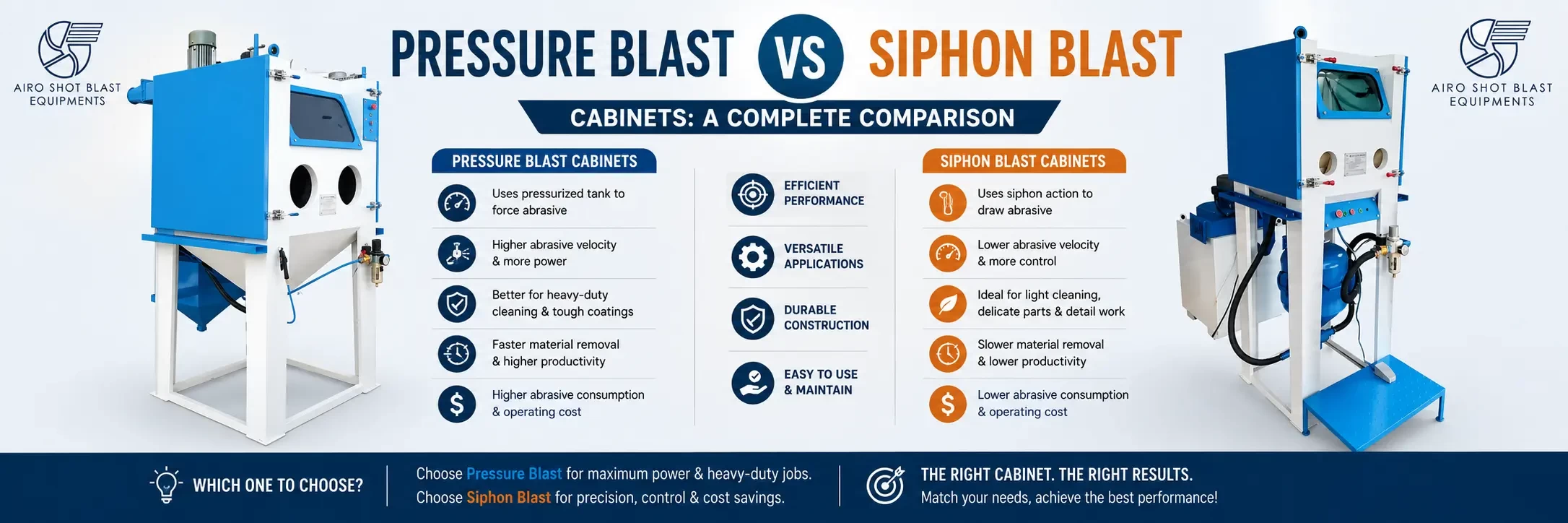
A pressure blast cabinet uses a pressurized vessel or blast pot to push abrasive media toward the nozzle. Compressed air is supplied to the pressure vessel, where the abrasive is stored under pressure. When the blasting cycle starts, the pressurized abrasive is forced through a sand blasting hose and exits the nozzle at high speed.
Because the media is already under pressure before it reaches the blast gun, this system typically produces a stronger, faster, and more aggressive blast stream. Pressure cabinets are often used for heavy-duty industrial blasting applications where faster cleaning and stronger cutting action are required.
What Is a Siphon Blast Cabinet?
A siphon blast cabinet, also commonly called a suction blast cabinet, works differently. In this system, compressed air passes through the blast gun and creates a vacuum effect that draws abrasive media up from the cabinet sand blasting hopper into the blast stream. Instead of being pushed from a pressurized pot, the abrasive is pulled into the gun by suction and then propelled toward the workpiece.
Siphon cabinets are widely used for general-purpose blasting, light to medium cleaning, deburring, surface finishing, and workshop maintenance. They are generally simpler in design and are often chosen for jobs where ultra-aggressive blasting power is not necessary.
For more info about the vacuum blasting machine, visit our webpage.
How Pressure and Siphon Cabinets Differ in Working Principle
The easiest way to understand the difference is to compare how the abrasive reaches the nozzle.
Pressure Pot blast Cabinet system
- Abrasive is stored in a pressurized vessel
- Compressed air pushes the abrasive media through the abrasive blasting hose
- The blast stream is more forceful and direct
- Cleaning speed is usually faster
Siphon blast system
- Abrasive is stored in the cabinet sand blasting hopper
- Air passing through the gun creates suction
- The media is drawn into the air stream
- Blasting is generally gentler and slower than pressure blasting
This difference in media delivery affects almost every other part of cabinet performance, including productivity, abrasive use, operating cost, and maintenance.
Blasting Cabinet Speed and Productivity
Blasting speed is one of the biggest differences between the two systems.
Pressure Blast Cabinets
A pressure blast cabinet usually cleans faster because the abrasive is delivered with more force and consistency. It removes rust, scale, paint, and heavy contamination more aggressively, which reduces cycle time per part. In production environments where many parts need to be processed every day, faster blasting can have a major effect on throughput and labor efficiency.
Siphon Blast Cabinets
A siphon cabinet system is typically slower because the abrasive is drawn into the blast stream rather than pushed under pressure. It can still clean effectively, but it may take more time to remove heavy rust, thick coatings, or stubborn scale. For low-volume or light-duty jobs, this slower pace may be perfectly acceptable. For high-volume industrial work, it may become a limitation.
Comparison takeaway
If speed and productivity are top priorities, pressure blasting usually has the advantage. If the workload is lighter and cycle time is less critical, a siphon cabinet may still be the more economical option.
Blasting Cabinet Power and Cleaning Aggressiveness
The next major comparison point is blasting force.
Pressure Blasting Cabinets
Pressure blasting cabinet systems deliver stronger impact energy at the nozzle. This makes them highly effective for:
- Heavy rust and mill scale removal
- Surface preparation before thermal spray or heavy coatings
- Cleaning castings and forged components
- Removing old industrial coatings
- Faster preparation of large metal parts
Siphon Blasting Cabinets
Siphon systems produce a softer and more controlled blast stream. That makes them useful for:
- Light rust removal
- Cleaning small parts
- Cosmetic finishing
- Glass bead blasting and satin finishing
- Deburring and gentle surface treatment
Comparison Takeaway
If the job requires aggressive cleaning and fast stock removal, pressure blasting is generally the better choice. If the work involves lighter cleaning, finishing, or delicate components, siphon blasting can offer better control.
Abrasive Blast Cabinet Surface Finish Quality
Blasting is not always about removing contamination as quickly as possible. In many industries, the goal is to create a specific surface texture or finish without damaging the part.
Pressure Sandblast Cabinet
Because they blast more aggressively, a pressure sandblast cabinet is excellent for strong surface preparation, but they can be too harsh for certain delicate components if pressure and media are not controlled carefully. They are ideal when the priority is deep cleaning, coating removal, or preparing a surface for bonding, painting, or powder coating.
Siphon Blast Cabinet
Siphon cabinets are often preferred for finishing work where control matters more than raw power. They are commonly used for bead blasting, cosmetic cleaning, light deburring, and producing more uniform visual finishes on softer or smaller parts.
Comparison Takeaway
For decorative finishing, lighter cleaning, and precision work, siphon blasting can be an advantage. For heavy-duty surface preparation, pressure blasting usually performs better.
Sand Blast Cabinet Abrasive Media Consumption
Abrasive cost is a major factor in long-term abrasive blasting cabinet operation. The two systems handle media differently, and that affects both consumption and wear.
Pressure Blasting Cabinet
Pressure systems can process jobs faster, which may reduce total blasting time, but they also deliver abrasive media more aggressively. Depending on the application, media may break down faster under high-pressure impact. However, because the cleaning is quicker, the overall job efficiency may still be better.
Siphon Blasting Cabinet
Siphon cabinets often use media more gently, which can be beneficial for certain finishing abrasives, such as glass beads abrasive. For lighter-duty work, this may help extend media life. However, if the cabinet takes significantly longer to complete the same cleaning job, the total media and labor cost may still rise.
Comparison Takeaway
There is no single universal winner here. Media economy depends on abrasive type, blast pressure, contamination level, and cycle time. Pressure blasting may consume media more aggressively per minute, while siphon blasting may use more time to finish the same job.
Sand Blasting Cabinet Cost and Initial Investment
Budget is one of the first things buyers consider.
Direct Pressure Sandblast Cabinet
Direct pressure sandblast cabinet is usually more expensive because they include a pressure vessel, additional control components, and a more powerful abrasive delivery system. They are built for stronger blasting performance and often for heavier industrial use.
Suction Blasting Cabinet
Siphon blasting cabinets are often more affordable as an entry-level or mid-range solution. Their design is simpler, and they can be a cost-effective choice for workshops that do not need high-speed heavy blasting.
Comparison Takeaway
If the budget is limited and the blasting application is moderate, a siphon cabinet may offer better value. If the sand blasting cabinet will be used heavily and productivity matters, the higher initial sand blast cabinet cost of a pressure cabinet may be justified by faster performance.
Sandblasting Cabinet Maintenance Requirements
Every blasting cabinet needs maintenance, but the type of system influences what must be monitored.
Pressure Sand Blasting Cabinet
Pressure sand blast cabinet systems require attention to the pressure vessel, remote control valves, media metering, blasting hoses, sand blasting nozzle wear, and overall pressure regulation. Because the abrasive moves with a higher force, wear on some components can be more aggressive. Preventive maintenance is important to keep the system stable and safe.
Siphon Sand Blasting Cabinet
Siphon systems are mechanically simpler, but they still require regular maintenance of the blast gun, pickup tube, sand blasting nozzle, abrasive media flow path, dust collector, gloves, and cabinet seals. Media flow issues can occur if the pickup system becomes blocked or if the abrasive becomes damp.
Comparison Takeaway
Siphon cabinets are often seen as simpler to operate and maintain, while pressure cabinets demand more attention but deliver higher blasting performance.
Best Use Cases for Pressure Blast Cabinets
Pressure pot blast cabinet is often the preferred choice when the work involves:
- Heavy rust, scale, and coating removal
- Faster processing of production parts
- Foundry cleaning and casting cleanup
- Industrial fabrication and steel preparation
- Harder substrates or thicker contamination layers
- Jobs where blasting time directly affects output and sand blast cabinet cost
They are especially valuable in industrial environments where productivity, aggressive cleaning, and repeatable performance are priorities.
Best Use Cases for Siphon Blast Cabinets
Siphon cabinets are commonly selected for:
- Light to medium-duty cleaning
- Workshop maintenance tasks
- Bead blasting and cosmetic finishing
- Deburring smaller machined parts
- Restoration work on delicate components
- Lower-volume blasting applications
- Buyers who want a simpler and lower-cost cabinet system
They are a practical choice for many service shops, maintenance departments, and smaller fabrication workshops.
Which Blasting Cabinet Is Better for Small Parts?
For small parts, the answer depends on the type of work being done.
If the goal is gentle cleaning, deburring, satin finishing, or a glass bead blasting machine, a siphon cabinet is often more suitable because it provides good control without excessive aggression. If the small parts are heavily rusted, coated, or require faster cycle times in production, a pressure cabinet may still be the better option.
The key is not the part size alone; it is the surface condition, production volume, and finish requirement.
Which Sand Blast Cabinet Is Better for Industrial Production?
For high-output industrial environments, pressure cabinets usually have the advantage because they clean faster and handle demanding jobs more efficiently. The stronger blast stream makes them better suited for repetitive blasting of metal components, fabricated assemblies, castings, and parts that require consistent pre-coating preparation.
That said, not every industrial process requires aggressive blasting. Some finishing lines still use siphon systems where the goal is controlled cosmetic treatment rather than heavy cleaning.
How to Choose Between Pressure and Siphon Blast Cabinets
The right choice depends on the application, not just the machine type. Before deciding, ask the following questions:
What type of contamination are you removing?
Heavy rust, scale, and industrial coatings usually point toward pressure blasting. Light oxidation, small burrs, or cosmetic cleaning may suit siphon blasting.
What finish do you need?
If the goal is aggressive surface preparation, pressure is often better. If the goal is a finer or more decorative finish, siphon may offer more control.
How many parts do you process per day?
Higher production volume often favors pressure cabinets because of faster blasting speed.
What is your budget?
Suction blaster cabinets generally have a lower initial sand blast cabinet cost, while pressure cabinets may offer better long-term value in high-production settings.
How important is maintenance simplicity?
Siphon systems are often simpler, while pressure systems offer more power but may require more involved setup and servicing.
What abrasive media will you use?
The media type, grain size, and intended finish can influence which cabinet design works best.
Choose a pressure blast cabinet if you need:
- Faster blasting speed
- Stronger cutting action
- Heavy rust or scale removal
- Industrial production efficiency
- More aggressive surface preparation
Choose a siphon blast cabinet if you need:
- Lower initial investment
- Simpler operation for general-purpose blasting
- Light to medium-duty cleaning
- Better control for bead blasting and finishing
- A practical workshop solution for smaller jobs
Pressure and siphon blast cabinets are both valuable abrasive blasting solutions, but they are designed for different priorities. Pressure cabinets are built for speed, aggressive cleaning, and industrial productivity. They are ideal when the work involves heavy contamination, larger workloads, and a strong surface preparation requirement. Siphon cabinets, on the other hand, are often the better fit for lighter cleaning, finishing, bead blasting, and lower-cost workshop applications where precision and simplicity matter more than raw blasting force. We are the sand blasting cabinet manufacturer in India and also a supplier of the abrasive blasting cabinet, pressure blasting cabinet, large sand blasting cabinet, manual sand blasting cabinet, benchtop sand blasting cabinet, automatic sand blasting cabinet, suction sand blaster, wet blasting cabinet, etc.
The best choice is the one that matches your actual process, not just the one with the most power or the lowest price. By comparing blasting speed, finish quality, abrasive handling, maintenance needs, and production volume, buyers can select a cabinet that improves efficiency, reduces operating cost, and delivers more reliable results for the long term.