ROI of Automated Sandblasting Cabinets
In modern manufacturing, surface preparation is no longer just a support process; it is a direct contributor to quality, productivity, delivery speed, and overall operating cost. Whether a business is removing rust, cleaning fabricated parts, preparing components for powder coating, or improving surface finish before assembly, the blasting stage has a measurable impact on production efficiency. This is where automated sand blasting cabinet technology has become increasingly valuable. This blog explains the ROI of automated sand blasting cabinets, how to evaluate the cost-to-benefit equation, and why automation can be a smart long-term investment for manufacturers, fabricators, foundries, automotive suppliers, and industrial finishing businesses.
For many workshops and factories, manual blasting cabinets are still useful for custom jobs, repair work, and low-volume production. But as production demands grow, manufacturers often begin asking a more strategic question: Is an automated blasting cabinet worth the investment? The answer depends on return on investment, not just the automatic sandblasting cabinet price. If automation reduces labour dependency, improves output consistency, cuts abrasive waste, lowers rework, and increases daily throughput, then the payback can be much faster than many buyers expect.
What Is an Automated Sand Blasting Cabinet?
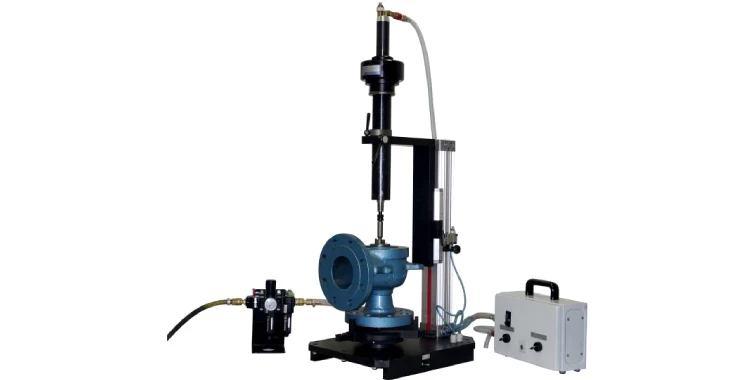
An automated sand blasting cabinet is a cabinet-based abrasive blasting machine system designed to perform blasting tasks with minimal manual intervention. Instead of relying entirely on an operator to hold and move the blast nozzle throughout the process, the cabinet uses automated motion, fixtures, turntables, indexing systems, programmable blasting cycles, or controlled nozzle movement to process parts more consistently and efficiently.
Depending on the design, automation can range from semi-automatic part rotation to fully programmed blasting cycles for repeat production jobs. These systems are especially useful in manufacturing environments where the same or similar parts are blasted repeatedly and where cycle time, finish consistency, and labour efficiency are important.
The term may also overlap with automatic sand blasting cabinet, automated sand blasting cabinets, and automated sand blasting cabinet, all of which are commonly used to describe cabinet systems that reduce manual blasting effort and improve process control.
Why ROI Matters More Than the Purchase Price of an Automatic Sandblasting Cabinet
One of the biggest mistakes industrial buyers make is evaluating blasting equipment only by upfront cost. A cheaper machine may look attractive on paper, but if it requires more labour, produces inconsistent finishing, consumes more abrasive, slows production, or increases rework, it may actually cost more over time than a higher-value automated system.
Return on investment is a better way to compare equipment because it focuses on how the automatic sand blasting machine affects long-term business performance. In blasting operations, ROI is influenced by several factors:
- Labor savings
- Higher production throughput
- Reduced blasting time per part
- Lower abrasive consumption
- Better finish consistency
- Less rework and rejection
- Improved dust control and cleaner operations
- Lower operator fatigue
- Better use of skilled labour for higher-value tasks
When all of these are measured together, the real value of automation becomes much clearer.
Where Automated Sand Blasting Cabinets Create Financial Value
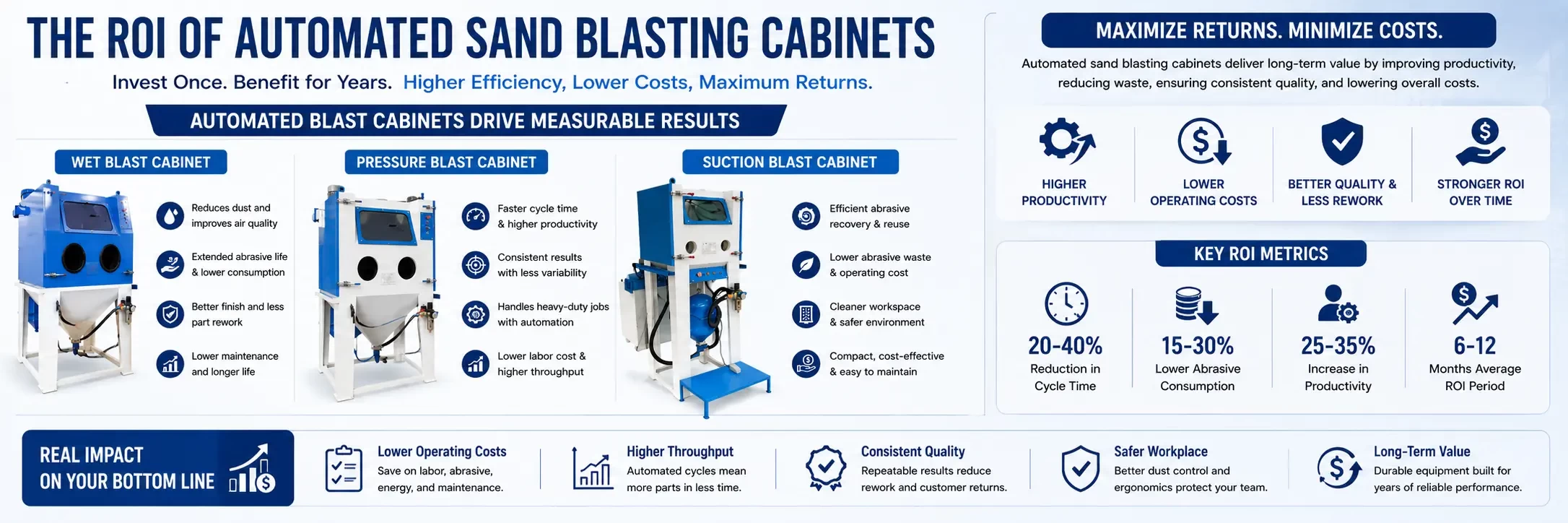
The ROI of an automated blasting cabinet usually comes from a combination of cost reduction and productivity improvement. The machine may not save money in only one area; instead, it creates a cumulative return across multiple parts of the production process.
1. Reduced Labour Dependency
A manual sand blasting cabinet depends heavily on operator time, skill, and physical effort. Every part must be positioned, blasted, rotated, and inspected by hand. In low-volume jobs, that may be perfectly acceptable. But in repetitive production environments, labour can quickly become one of the highest operating costs.
An automated cabinet reduces this dependency by performing repetitive blasting motions through programmed or semi-automatic systems. That means one operator may be able to supervise the process, load and unload parts, or manage multiple production tasks instead of manually blasting each component from start to finish.
ROI impact:
- Fewer labour hours per part
- Better use of available operators
- Reduced reliance on highly repetitive manual work
- Improved output even when labour availability is limited
For businesses facing labour shortages or rising wage costs, this alone can justify the move toward automation.
2. Faster Cycle Time and Higher Throughput
In manufacturing, time is one of the highest hidden costs. If a manual sand blasting cabinet takes too long to clean, strip, or finish each part, the blasting stage can become a bottleneck that delays downstream operations such as coating, assembly, packing, or dispatch.
Automated blasting cabinets are designed to process repeat jobs faster because the blasting path, pressure, part movement, and cycle timing can be standardised. Instead of relying on different operator speeds or inconsistent blasting coverage, the process is repeated in a controlled way.
ROI impact:
- More parts processed per shift
- Better production planning
- Faster order turnaround
- Reduced backlog in finishing operations
- Higher machine utilisation in repetitive work
When output increases without a matching increase in labour cost, the return on investment becomes easier to measure.
3. More Consistent Surface Finish
Surface preparation quality matters because it directly affects downstream performance. Inconsistent blasting can cause uneven cleaning, poor coating adhesion, visible finish variation, or incomplete rust removal. These issues often lead to rework, product rejection, delayed delivery, or customer complaints.
Automation helps standardise blasting intensity, coverage, timing, and part exposure. This is especially useful for parts that require a repeatable finish across multiple batches.
ROI impact:
- Lower rejection rate
- Reduced rework cost
- More consistent coating adhesion
- Improved finish quality across production lots
- Better customer confidence in finished components
In industries where blasting is a preparation step before painting or powder coating, finish consistency can be one of the biggest hidden sources of savings.
4. Lower Abrasive Waste and Better Media Utilisation
In manual blasting, abrasive consumption can vary from operator to operator. Some operators may blast longer than necessary, use inconsistent sand blasting nozzle distances, or spend too much time on certain areas of the part. This leads to unnecessary media consumption and higher operating costs.
Automated cabinets help optimise abrasive use by keeping blasting cycles controlled and repeatable. The part receives the required treatment without excessive overblasting. When the cabinet also includes a good recovery and dust collection system, reusable media can be managed more efficiently.
ROI impact:
- Lower abrasive consumption per part
- More predictable media usage
- Reduced dust and broken media loss
- Better long-term control over consumable costs
For businesses using aluminium oxide, glass beads, steel grit, or other reusable abrasives, this cost reduction can add up significantly over a year of production.
5. Reduced Operator Fatigue and Better Workplace Efficiency
Manual blasting can be physically demanding, especially when the job involves repetitive work, heavier components, awkward angles, or long blasting cycles. Operator fatigue often reduces speed, concentration, and finish consistency over time. It may also increase the likelihood of errors or poor blasting coverage during long shifts.
An automated cabinet removes much of this repetitive physical burden. Instead of manually controlling the blast stream for the full cycle, the operator focuses more on loading, unloading, monitoring, and quality checks.
ROI impact:
- More stable output across the shift
- Lower physical strain on workers
- Better morale in repetitive production environments
- Less variability caused by fatigue or technique differences
While this benefit may seem indirect, it contributes to smoother operations and better long-term productivity.
Comparing Manual vs Automated Sand Blasting Cabinet ROI
To understand ROI properly, it helps to compare the two systems beyond the machine purchase price.
Manual Sand Blasting Cabinet advantages
- Lower initial investment
- Flexible for mixed jobs and one-off parts
- Suitable for small workshops and repair work
- Easier entry point for low production volume
Automated Sand Blasting Cabinet Advantages
- Better for repetitive production
- Lower labour cost per part
- More consistent blasting quality
- Faster cycle time
- Improved throughput
- More predictable operating costs
- Better scalability for growing demand
If a business only blasts occasional custom parts, the ROI of automation may be slower. But if the same type of component is blasted repeatedly every day, an automated system usually creates stronger long-term value.
How to Calculate ROI for an Automated Sand Blasting Cabinet
Every business will calculate ROI differently, but the basic approach is straightforward. The goal is to compare the annual savings and productivity gains from automation against the total investment cost of the machine.
Step 1: Calculate the current manual blasting cost
Include:
- Labour hours per day or per shift
- Abrasive media consumption
- Rework and rejection cost
- Downtime caused by slow blasting
- Maintenance cost of the existing setup
- Production delays linked to blasting bottlenecks
Step 2: Estimate the performance of the automated system
Consider:
- Reduced labour hours
- Increased parts processed per shift
- Lower media waste
- Lower rework percentage
- Faster turnaround for downstream operations
- Improved quality consistency
Step 3: Measure the annual gain
Subtract the expected annual operating cost of the automated cabinet from the current cost of manual blasting. The difference represents your yearly benefit.
Step 4: Compare that benefit to the machine investment
If the automated cabinet costs ₹10 lakh, for example, and the total annual savings plus productivity gain is ₹4 lakh, the payback period is approximately 2.5 years. In some production environments, especially where blasting is a daily bottleneck, the payback can be much faster.
Which Industries Benefit Most from Automated Sand Blasting Cabinets?
Not every business needs the same level of automation. However, automated cabinet systems tend to deliver the strongest ROI in industries with repeat production, consistent part geometry, and frequent blasting requirements.
- Automotive and auto-component manufacturing: Automotive suppliers often process similar brackets, housings, fabricated parts, and machined components in batches. Automation improves repeatability and reduces labour costs in these repetitive cycles.
- Foundries and casting finishing operations: Small to medium castings that require repeated cleaning, oxide removal, or surface preparation can often benefit from automated cabinet blasting, especially when the same part design is processed regularly.
- Fabrication and coating lines: When blasting is part of the pre-paint or pre-powder-coating process, automation helps maintain a consistent finish and prevents blasting from becoming a production bottleneck.
- Aerospace and precision engineering: For selected precision parts, automation can improve process consistency and repeatability, especially when specific surface treatment standards must be maintained across multiple components.
- Industrial job-work blasting units: Service providers handling high volumes of similar customer parts can often improve turnaround time and capacity with automation, provided the workload is repetitive enough.
For more info about the grit blasting machine, visit our website.
When an Automated Sand Blasting Cabinet May Not Be the Best ROI
Automation is not automatically the best choice for every operation. In some situations, a manual or semi-automatic cabinet may offer better value. An automated system may not deliver a strong ROI when:
- Production volume is low or irregular
- Most jobs are custom one-off parts
- Workpiece shapes vary too much for standardised blasting cycles
- The business has limited floor space or compressed-air capacity
- The budget does not support proper automation integration
In these cases, a good-quality manual pressure or suction cabinet may still be the more practical investment.
How to Maximise ROI After Buying an Automated Blasting Cabinet
Buying the machine is only the first step. To get the full financial return, the system must be integrated properly into the production process.
Best practices to improve ROI include:
- Choose the cabinet size based on actual part dimensions and future workload
- Match the blasting media to the application for better speed and finish quality
- Train operators on setup, fixture loading, and maintenance
- Use reliable dust collection and abrasive recovery systems
- Standardise blasting cycles for repeat jobs
- Monitor abrasive consumption and nozzle wear
- Track parts per shift before and after automation
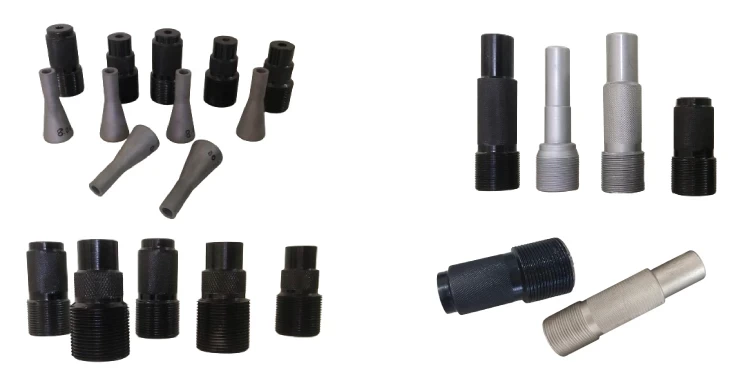
- Prevent downtime with planned maintenance and sand blasting machine spare parts availability
When these factors are managed well, the automated cabinet becomes more than a machine; it becomes a productivity asset.
The ROI of an automated sandblasting cabinet is not just about replacing manual blasting with a more advanced machine. It is about improving the economics of the entire surface preparation process. A well-chosen automated system can reduce labour dependency, increase throughput, improve finish consistency, lower abrasive waste, reduce rework, and support faster delivery in production environments where blasting is a regular part of manufacturing.
For low-volume workshops or highly customised blasting work, the manual cabinet and benchtop sand blasting cabinet may still be the right fit. But for businesses handling repeat parts, growing production demands, or quality-sensitive finishing operations, automation can create a measurable and often compelling return on investment. The real question is not whether an automated cabinet costs more upfront. The better question is how much time, labour, waste, and lost productivity the right automation can save over the life of the machine.