What Is a Sand Blast Cabinet and How Does It Work?
Surface preparation is one of the most important steps in metal finishing, fabrication, restoration, and industrial maintenance. Whether the goal is to remove rust, strip old paint, clean castings, deburr machined parts, or prepare a surface for powder coating, blasting remains one of the most effective and widely used methods. Among the different blasting solutions available, the sandblast cabinet is one of the most practical options for controlled, clean, and repeatable abrasive blasting. In this blog, we’ll explain what a sandblast cabinet is, how it works, its key components, the different types available, and how to choose the right model for your workshop or industrial application.
Unlike open blasting, where abrasive media is projected onto a surface in an exposed work area, a sandblast cabinet performs the blasting process inside an enclosed chamber. This makes the operation cleaner, safer, more media-efficient, and easier to control. It also helps reduce dust spread, improve operator visibility, and deliver more consistent results for both light-duty and heavy-duty surface preparation jobs.
What Is a Sandblast Cabinet?
A sandblast cabinet is an enclosed abrasive blasting machine designed to clean, finish, roughen, or prepare surfaces by directing abrasive media at high speed onto a workpiece inside a sealed cabinet chamber. The cabinet allows the operator to blast parts through built-in gloves and a viewing window while containing the abrasive media and dust within the system.
The term is often used interchangeably with sand blast cabinet, especially in industrial and commercial applications. These cabinets are widely used for cleaning metal parts, removing oxidation, stripping paint, preparing weld joints, restoring automotive components, cleaning tools, and producing a uniform finish on fabricated or machined parts.
The biggest advantage of a sandblast cabinet is control. Because the blasting takes place inside a cabinet, the operator can manage the process more precisely, recover reusable abrasive media, and keep the surrounding workspace cleaner than with open blasting methods.
Why Sandblast Cabinets Are Used in Industrial and Workshop Applications
A sandblast cabinet is useful wherever parts need controlled surface treatment without exposing the surrounding work area to flying abrasive and heavy dust. Instead of blasting in the open, the cabinet contains the process within a dedicated enclosure. This improves cleanliness, abrasive recovery, and process consistency.
Typical applications include:
- Rust removal from metal parts
- Paint and coating removal
- Cleaning castings and fabricated components
- Deburring machined parts
- Surface roughening before painting or powder coating
- Finishing stainless steel, aluminium, brass, and mild steel parts
- Restoration of automotive and engineering components
- Cleaning tools, molds, and mechanical parts
From small workshops to heavy industrial production units, blast cabinets help make abrasive blasting more controlled and efficient.
For more info about the automatic sand blasting cabinet, visit our webpage.
How Does a Sandblast Cabinet Work?
To understand the value of a cabinet system, it helps to look at how does sandblast cabinet work in a real blasting environment.
A sandblast cabinet works by using compressed air or pressure to accelerate abrasive media through a blast gun or nozzle and direct it at the workpiece placed inside the cabinet. The abrasive impacts the surface, removing rust, paint, scale, burrs, oxidation, or other unwanted layers. The used abrasive and dust then fall or are drawn into the cabinet’s recovery and dust collection system, allowing the process to continue in a contained cycle.
Although different cabinet designs vary in features and blasting method, the general working principle follows the same sequence.
The Workpiece Is Placed Inside the Cabinet
The component or part to be cleaned is placed inside the cabinet through a front door, side door, or top-opening access panel, depending on the cabinet design. Once the part is loaded, the cabinet is closed to create a sealed blasting chamber.
The size of the cabinet determines the maximum size of the parts it can handle. Smaller workshop units are suitable for tools, brackets, and compact components, while larger industrial systems can process fabricated assemblies, castings, and bulkier workpieces.
For more info about the wet blasting machine, visit our webpage.
Abrasive Media Is Stored in the Cabinet or Pressure System
The cabinet uses abrasive media such as aluminium oxide, glass beads, garnet, silicon carbide, or steel grit, depending on the blasting application. In a suction cabinet, the media is drawn from a hopper or collection area into the blast gun. In a pressure cabinet, the media is pressurized in a blast pot or pressure vessel and delivered to the nozzle more aggressively for faster cleaning.
The Operator Uses Gloves to Control the Blast Gun
Most manual cabinets include built-in heavy-duty gloves attached to the cabinet front. The operator inserts their hands into these gloves and controls the blast gun from outside the sealed chamber. This allows blasting to be performed without direct exposure to abrasive rebound.
The operator points the nozzle at the part and moves it across the surface to remove contamination, clean the metal, or create the required surface finish.
Abrasive Strikes the Surface and Removes Contamination
As the blast stream hits the workpiece, the abrasive cuts, cleans, peens, or etches the surface depending on the media type, blasting pressure, and part material. This action can remove rust, scale, carbon deposits, paint, old coatings, burrs, or surface contamination.
The blasting result depends on several factors:
- Abrasive type and size
- Air pressure or blast pressure
- Nozzle design
- Distance from the workpiece
- Duration of blasting
- Material of the part being treated
Dust and Broken Abrasive Are Removed by the Dust Collector
During blasting, fine dust is generated from broken abrasive particles and the material removed from the workpiece. A dust collector connected to the cabinet extracts this airborne dust to maintain visibility inside the chamber and keep the abrasive media cleaner for reuse.
Without proper dust collection, the operator’s view becomes clouded, and blasting quality drops. That is why dust extraction is one of the most important parts of any cabinet system.
Reusable Abrasive Is Recovered for Continued Blasting
In many cabinets, reusable abrasive falls into a hopper or recovery section after blasting. It can then be recirculated back into the blasting system, reducing media waste and improving operating efficiency. This closed-loop process is one of the reasons cabinet blasting is more economical and controlled than open blasting for many applications.
Main Components of a Sandblast Cabinet
Although cabinet sizes and configurations vary, most systems include the following core components:
Sand blast cabinet body: The main enclosed chamber where blasting takes place. It is usually made from fabricated steel and designed to resist abrasive wear.
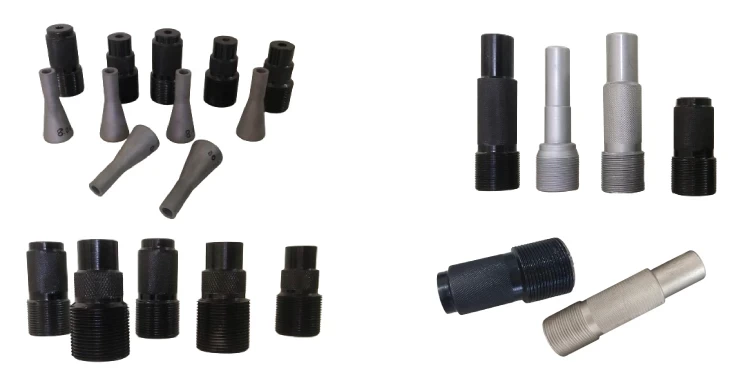
Sand blast gun and nozzle: The gun directs abrasive media at the workpiece. The sand blasting nozzle controls the flow pattern and velocity of the blast stream.
Gloves: Mounted on the front of the cabinet so the operator can handle the blast gun and parts without direct contact with the abrasive.
Sand blast cabinet viewing window: A transparent inspection panel that allows the operator to see the blasting process inside the cabinet.
Dust collection system: Removes airborne dust and helps maintain visibility and cleaner internal conditions.
Abrasive hopper or recovery system: Stores and recovers blasting media for repeated use.
Air supply connection: Provides the compressed air needed to power the blasting process.
Sandblast cabinet light: A sandblast cabinet light is essential for visibility, especially when blasting dark surfaces, intricate parts, or fine-finish components. Good lighting improves accuracy, reduces missed areas, and helps the operator monitor surface condition during blasting.
Importance of Cabinet Glass and Visibility: Visibility is critical in any blasting operation. If the operator cannot see the part clearly, blasting becomes slow, uneven, and less accurate. That is why sandblast cabinet glass plays an important role in cabinet performance.
The viewing panel is designed to give a clear view into the blasting chamber while protecting the operator from rebounding abrasive. Over time, blasting environments can wear the inner protective layers of the window, especially if dust extraction is poor or abrasive rebound is heavy. For this reason, some cabinets use replaceable protective films or sacrificial glass layers to extend visibility and window life.
The same consideration applies when buyers search for sand blast cabinet glass as a replacement or maintenance item. Good-quality viewing glass and proper dust extraction help maintain safer and more productive operations.
Types of Sandblast Cabinets
Sandblast cabinets are available in different sizes and blasting methods depending on the type of work and production volume.
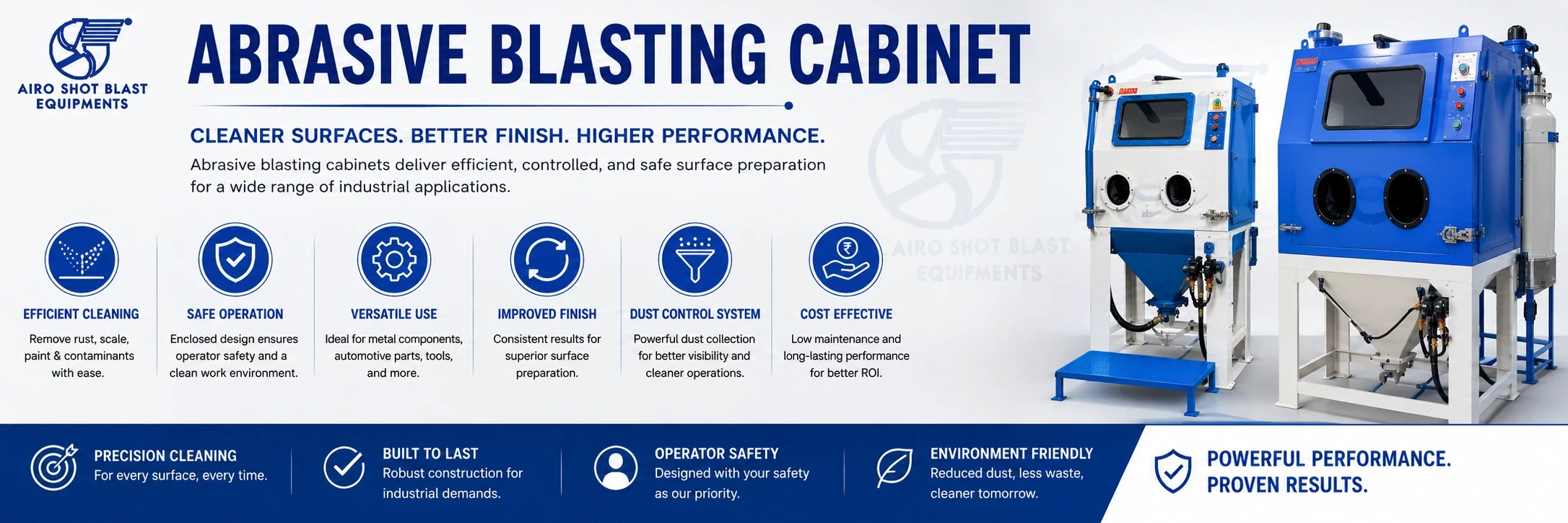
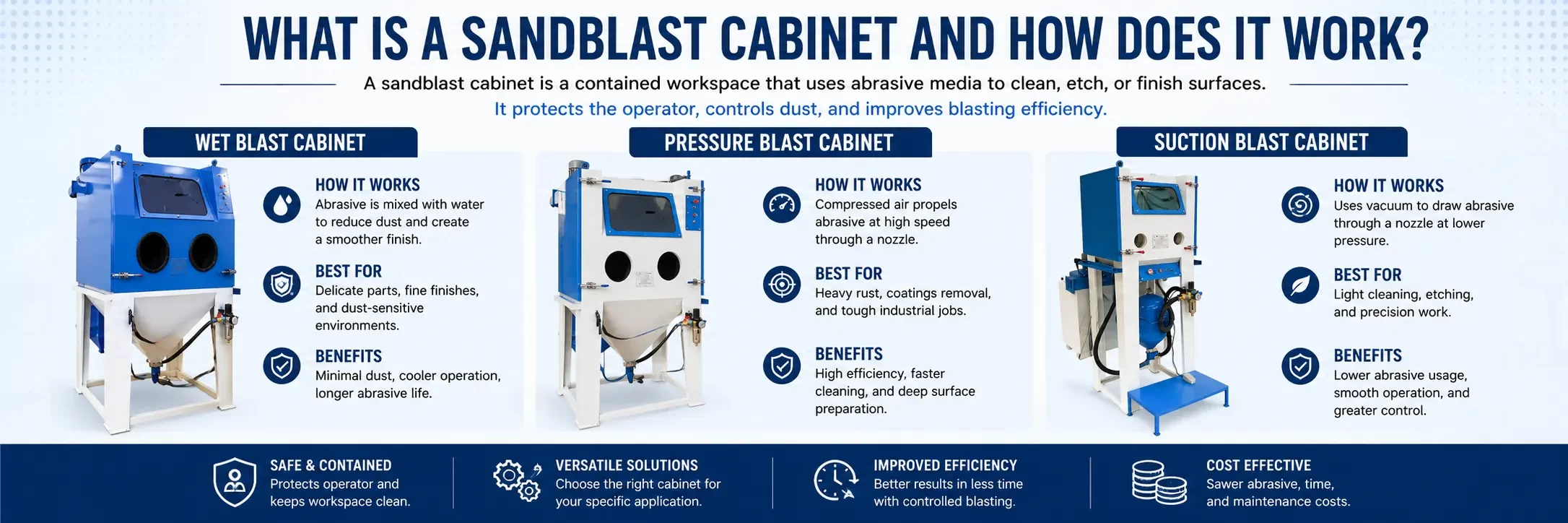
Suction Sandblast Cabinet
A suction blasting cabinet draws abrasive media into the blast gun using compressed air. These cabinets are commonly used for general cleaning, light to medium-duty blasting, deburring, and workshop applications. They are often simpler and more economical than pressure systems.
Best for:
- Light rust removal
- Cleaning small fabricated parts
- Workshop maintenance work
- Glass bead finishing and light abrasive blasting
Pressure Sandblast Cabinet
A pressure sandblast cabinet uses a pressurized vessel or pressure pot to feed abrasive media to the blast gun. This method delivers higher blasting force and generally faster cleaning compared to suction blaster systems.
Best for:
- Heavier rust and scale removal
- Faster blasting cycles
- Tough industrial cleaning jobs
- Surface preparation on hard coatings and heavily contaminated parts
Pressure blasting cabinets are often preferred in production environments where speed and aggressive blasting performance are priorities.
Tabletop and Mini Sand Blasting Cabinets
Benchtop sand blasting cabinets are designed for compact parts and light-duty work. A tabletop sand blast cabinet is ideal where floor space is limited, and the work involves smaller components such as tools, fittings, brackets, carburetor parts, jewelry components, or precision engineering items.
Similarly, a mini sand blast cabinet is suitable for workshops, hobby use, service centers, and small repair jobs where a full-size industrial cabinet would be unnecessary.
Best for:
- Small workshops
- Precision parts cleaning
- Restoration jobs
- Bench-level blasting operations
- Low-volume component finishing
Large Sand Blasting Cabinets
A large sand blast cabinet is built for bigger components, higher work volume, or industrial production environments where larger fabricated parts, castings, housings, or assemblies need controlled blasting inside an enclosed chamber.
A large sand blasting cabinet may include larger doors, stronger dust collectors, more powerful blasting systems, turntables, foot pedals, and customized internal layouts for heavier jobs.
Best for:
- Industrial fabrication
- Foundry cleaning
- Automotive and engineering components
- Large castings and structural parts
- Repetitive production blasting
Key Benefits of Using a Sandblast Cabinet
- Cleaner and more controlled blasting: Because the blasting process takes place inside a cabinet, dust and abrasives are contained far better than in open blasting environments.
- Better abrasive recovery: Reusable media can be collected and recirculated, reducing waste and operating costs.
- Improved surface preparation quality: The enclosed environment helps the operator maintain better control over blasting angle, duration, and part coverage.
- Safer working conditions: A cabinet reduces direct exposure to rebounding abrasive and helps manage dust with the right extraction system.
- Suitable for a wide range of parts: From small precision components to larger industrial workpieces, cabinets can be selected to match the application.
How to Choose the Right Sandblast Cabinet
Selecting the right cabinet depends on the job, the size of the workpieces, the blasting frequency, and the type of finish required.
Consider the following before buying:
- Size and shape of the parts to be blasted
- Type of contamination being removed
- Required surface finish
- Production volume and daily operating hours
- Type of abrasive media you plan to use
- Whether suction or pressure blasting is better for the job
- Dust collection quality and maintenance access
- Visibility features such as lighting and viewing window design
- Availability of spare parts and service support
For small repair work or bench-level jobs, a mini or tabletop cabinet may be enough. For heavy rust removal, industrial cleaning, or faster cycle time, a pressure cabinet may be the better choice. For larger fabricated parts, a large industrial cabinet will provide the working space and durability required.
A sandblast cabinet is one of the most practical and efficient solutions for controlled abrasive blasting. Enclosing the abrasive blasting cabinet process inside a dedicated chamber, it helps remove rust, paint, scale, burrs, and contamination while improving cleanliness, abrasive recovery, visibility, and process control. Whether used in a small workshop, restoration unit, fabrication shop, or industrial production facility, a well-designed cabinet makes blasting safer, cleaner, and more consistent than many open blasting alternatives.
Understanding how a sandblast cabinet works is the first step toward selecting the right system. From mini and tabletop models to pressure cabinets and large industrial units, the best cabinet is the one that matches your parts, blasting workload, surface finish requirements, and operating environment. When selected properly and paired with the right dust collection, lighting, and abrasive media, a sandblast cabinet becomes a highly valuable tool for efficient surface preparation and finishing.